
-
NewsBlur has always been great at reading feeds. But finding new ones? That was mostly on you. The old “Add Site” dialog was a search box and not much else. If you already had a feed URL, it worked fine. If you were looking for something new to read, you were on your own.
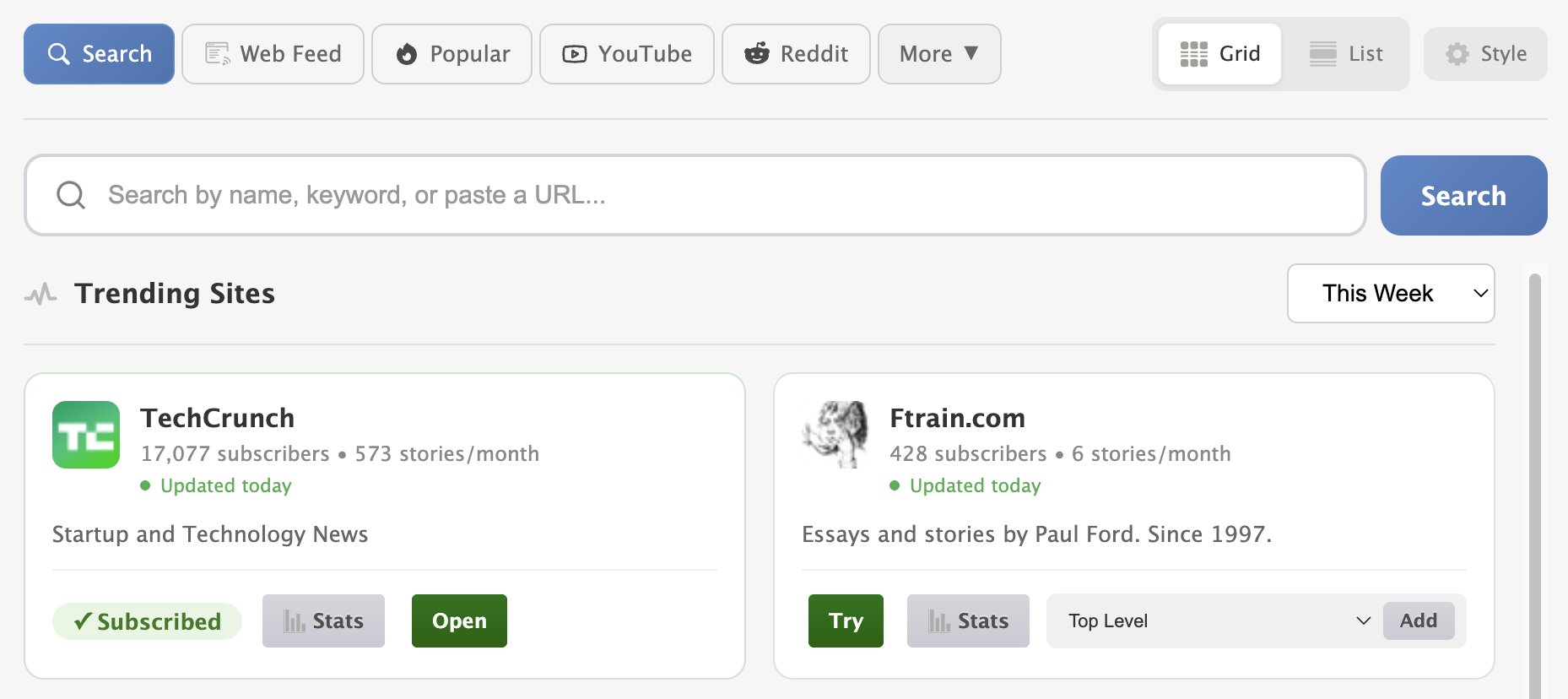
The new Add + Discover Sites page changes that. It’s a full-page discovery experience with eight tabs covering YouTube channels, Reddit communities, podcasts, newsletters, Google News topics, trending sites, popular feeds, and of course the classic search-and-subscribe workflow. There are over 50,000 curated feeds to browse, all organized into dozens of categories and subcategories.
Eight ways to find feeds
The tab bar across the top gives you eight different lenses into the world of RSS:

-
Search — The classic search bar, now with semantic search and autocomplete. Type a topic or URL and get instant suggestions. Below the search results you’ll find trending feeds ranked by a hybrid algorithm that combines subscription velocity, read engagement, and subscriber counts.
-
Web Feed — Create RSS feeds from any website. This one gets its own blog post.
-
Popular Sites — Thousands of curated RSS feeds organized into categories like Technology, Science, News, and Business. Each category has subcategories for drilling down further.
-
YouTube — Over 2,000 verified YouTube channels converted to RSS feeds. Browse by category or search for specific channels. Subscribe and read YouTube in your feed reader the way it should be.
-
Reddit — Nearly 6,000 real subreddits across 47 categories. From r/programming to r/sourdough, you can subscribe to any subreddit as an RSS feed.
-
Newsletters — Newsletters from Substack, Medium, Ghost, Beehiiv, and other platforms. Platform pills let you filter by newsletter provider if you have a preference.
-
Podcasts — Popular podcasts organized by genre. Search for shows or browse the curated collection.
-
Google News — Eight preset topics (World, Business, Technology, Sports, and more) that create feeds from Google News. One click to subscribe.
Categories and subcategories
Most tabs are organized with a two-level taxonomy. Click a category pill at the top to filter, then drill into subcategories for more specific browsing. YouTube’s Technology category, for example, breaks down into Programming, AI & Machine Learning, Gadgets, and more.
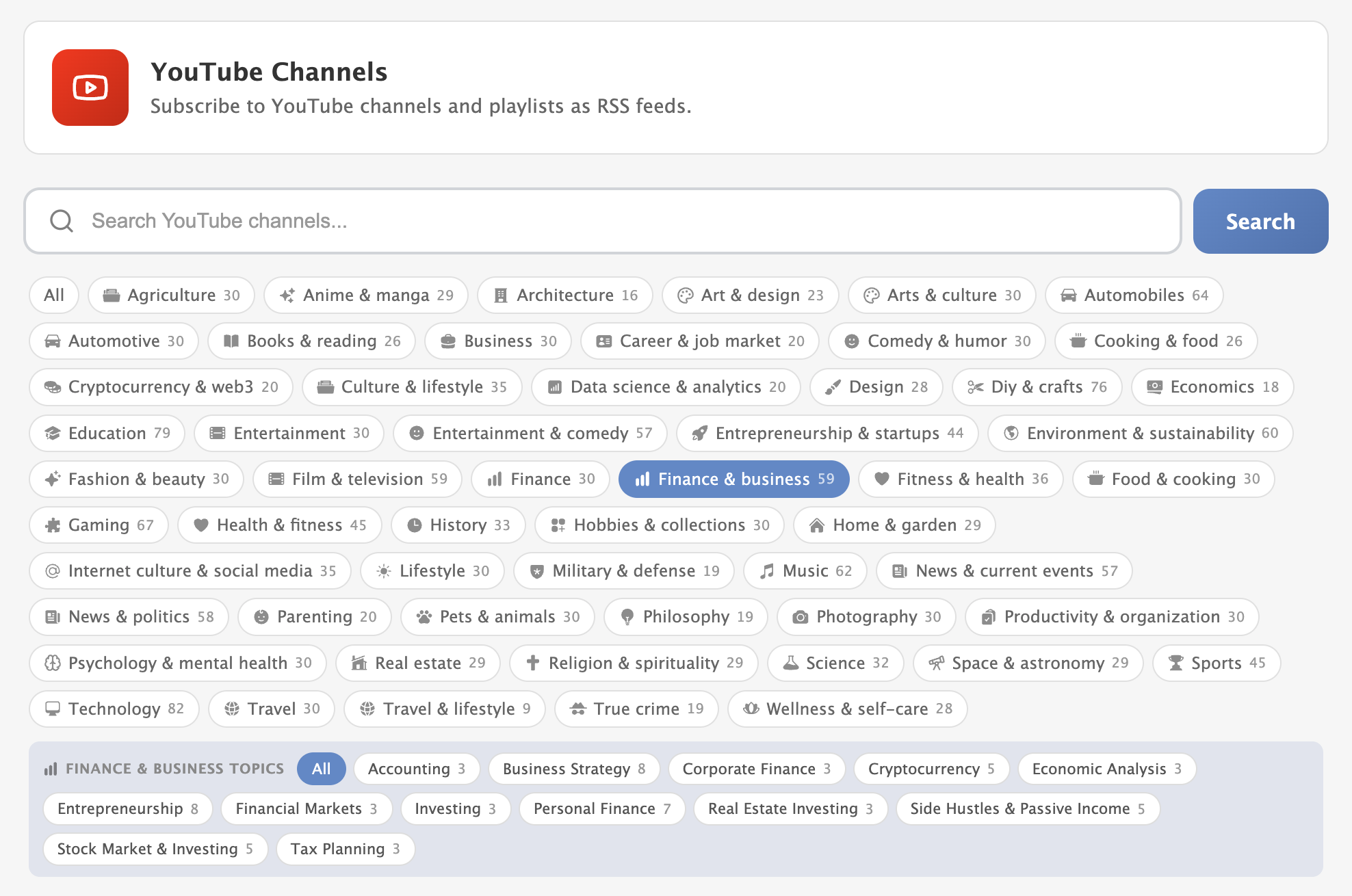
The categories are consistent across tabs where it makes sense, so you can explore Technology feeds across YouTube, Reddit, Popular Sites, and Podcasts without having to rethink the navigation each time.
Grid view and list view
Every tab supports two viewing modes. Grid view shows feed cards with thumbnails, descriptions, subscriber counts, and freshness indicators. List view compresses things into a denser layout when you want to scan quickly.
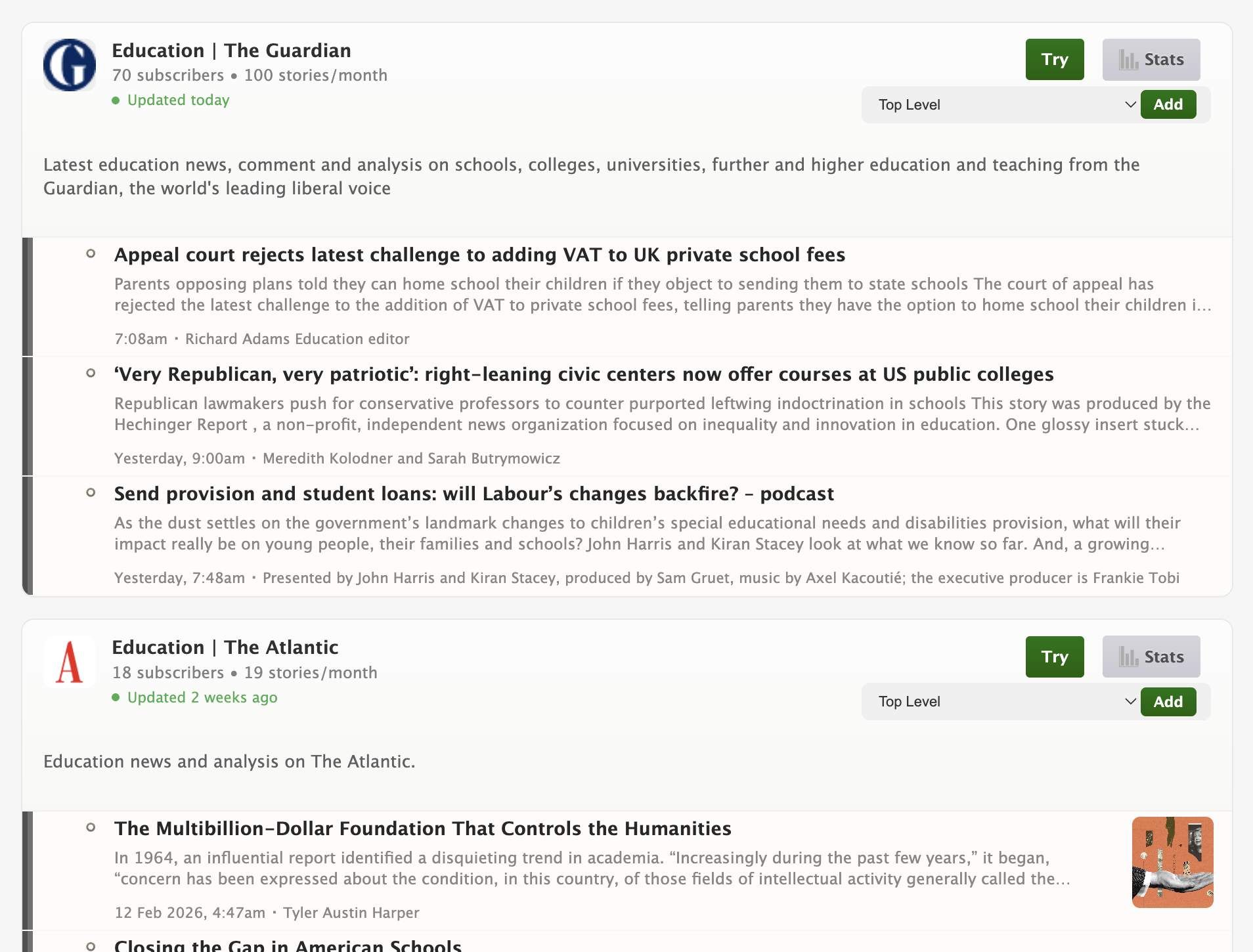
A style popover in the top right lets you toggle between views. Your preference is saved per tab.
Try before you subscribe
Every feed card has a Try button that instantly fetches the feed and shows you the actual stories. No commitment, no subscribing. Just a quick look at what you’d get. If you like what you see, the subscribe button is right there with a folder picker.
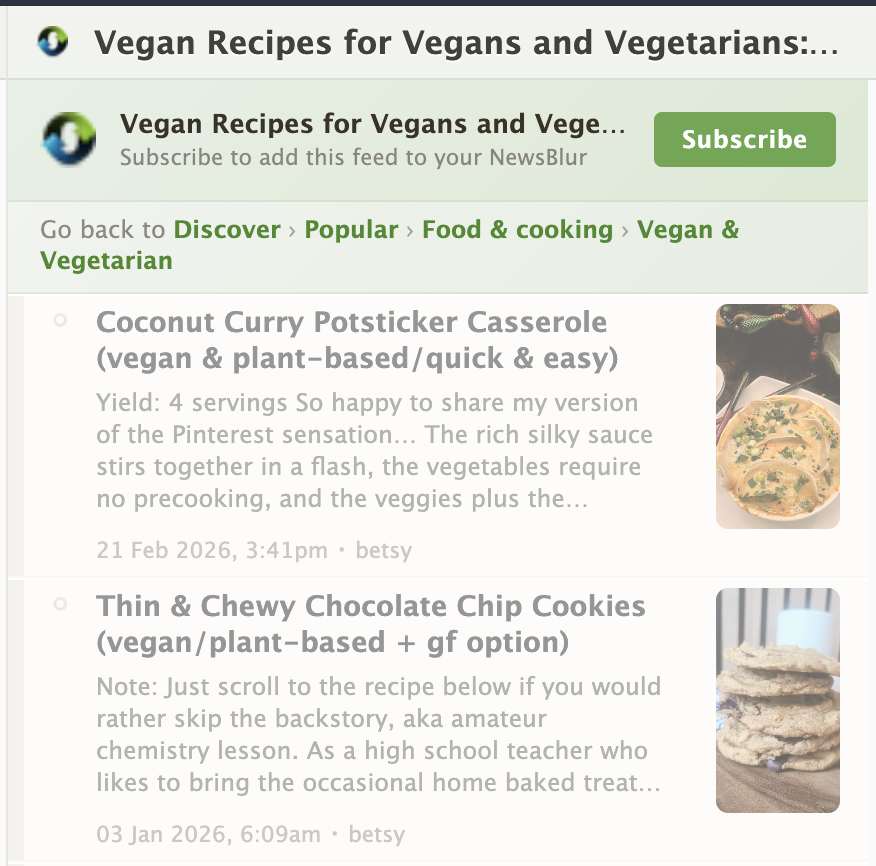
A breadcrumb link at the top takes you back to where you were browsing when you’re done previewing.
The new Add Site popover
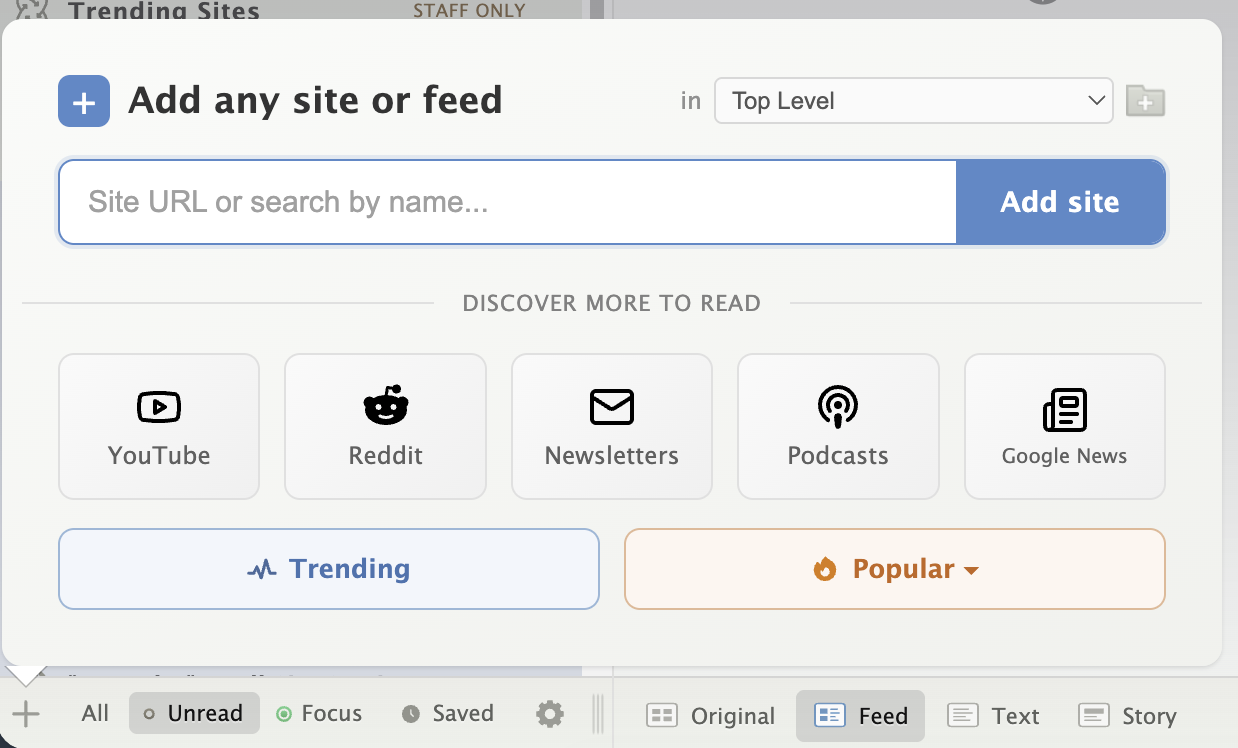
If you don’t need the full discovery page, the popover that appears when you click “+” in the sidebar has been redesigned too. It still has the quick URL input for when you have a feed address handy, but now it also shows freshness indicators and has buttons to jump into any of the discovery tabs.
Semantic search
The search tab uses Elasticsearch to find feeds by name with fuzzy matching. Type “cooking” and you’ll get cooking blogs, YouTube cooking channels, cooking subreddits, and cooking podcasts. It searches across all feed types, not just traditional RSS. If Elasticsearch doesn’t find anything, the search falls back to a database query so you’ll always get results.
Where all these feeds came from
Building the discovery page meant curating a lot of feeds. I wrote management commands to discover and verify channels, subreddits, podcasts, and newsletters from real sources. The collection includes over 2,000 YouTube channels, 6,600 subreddits, 7,300 newsletters, 32,000 podcasts, and 14,000 RSS feeds. Over 63,000 feeds in total, all real, verified, and categorized.
The Add + Discover Sites page is available now on the web for all users. If you have feedback or ideas for new categories, platforms, or features, please share them on the NewsBlur forum.
-
-
A lot of the sites I subscribe to have audio and video embedded directly in the stories. Podcasts, YouTube channels, news clips. But playing them in NewsBlur has always been a bit awkward: you hit play on the native browser control, then if you scroll to the next story or switch feeds, the audio just stops. I wanted something that keeps playing while you keep reading.
So I built a persistent mini media player. It sits at the bottom of your screen and handles audio, video, and YouTube from any story. Play something and it stays with you as you navigate feeds, open folders, or scroll through stories.
How it works
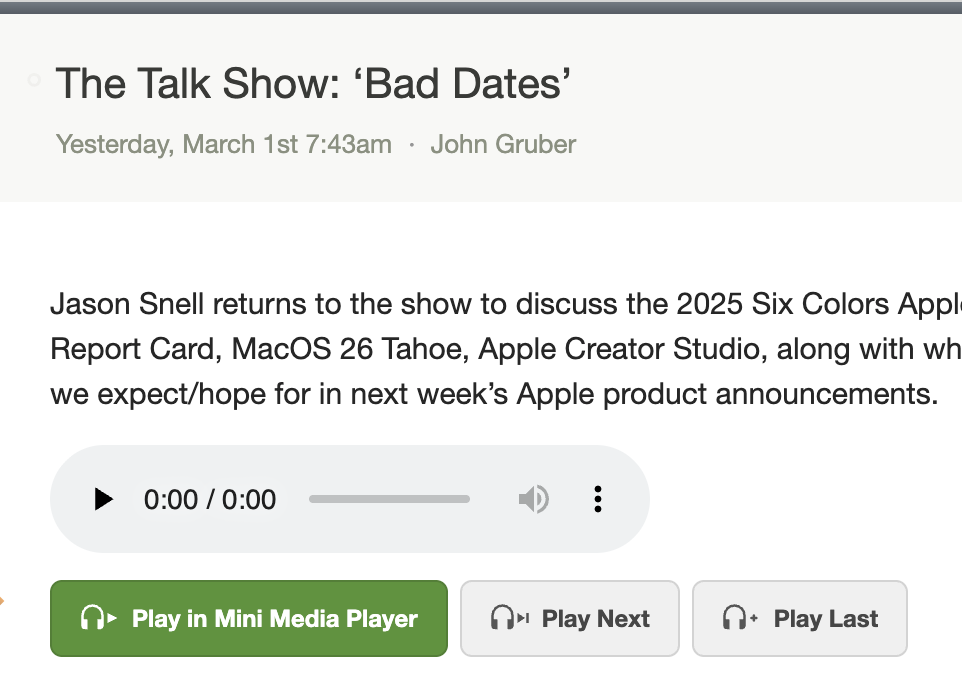
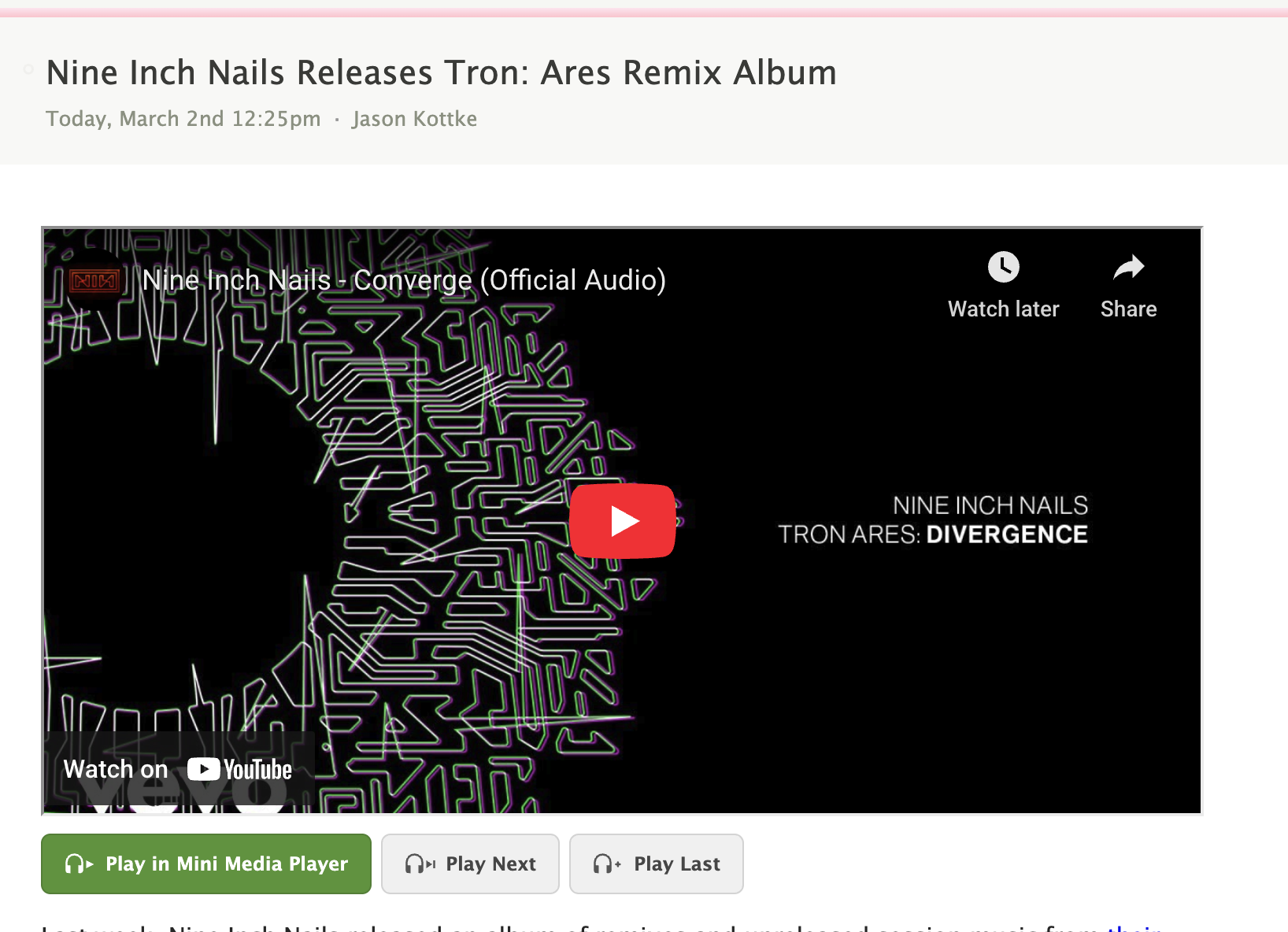
When you open a story that contains audio, video, or a YouTube embed, you’ll see overlay buttons right on the media element: Play in Mini Media Player, Play Next, and Play Last. Click any of them and the mini player appears at the bottom of the screen. If you click the native play button on an audio or video element, it hands off to the mini player automatically.
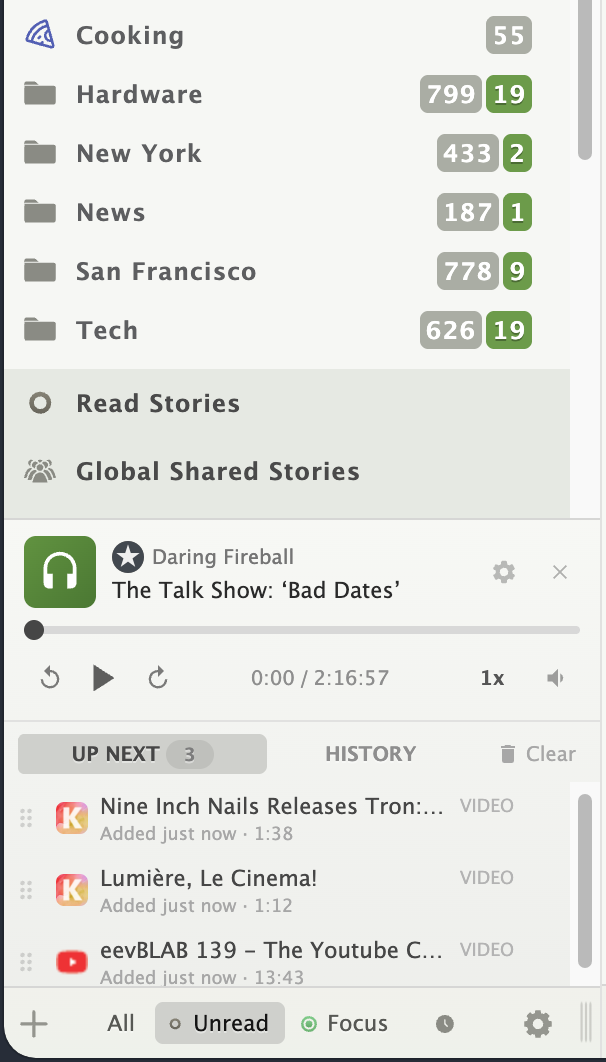
The player has a three-row layout. The top row shows the feed favicon, feed name, and story title (click the title to scroll back to the story). The middle row is a full-width scrubber so you can seek precisely. The bottom row has playback controls: skip back, play/pause, skip forward, a time display, playback speed, and a volume slider that appears on hover.
Build a queue
The real power is the queue. As you’re reading through stories, you can add media to your queue with “Play Next” (inserts at the top) or “Play Last” (appends to the end). The queue shows up right below the player with a count of upcoming items. Drag items to reorder them, or remove items you’ve changed your mind about. When the current item finishes, the next one starts automatically.
Playback history
Switch from the “Up Next” tab to the “History” tab to see your last 10 played items. Each entry shows where you left off, so you can pick up a podcast episode right where you stopped. Click any history item to resume it.
Settings
Click the gear icon in the player to customize your experience:
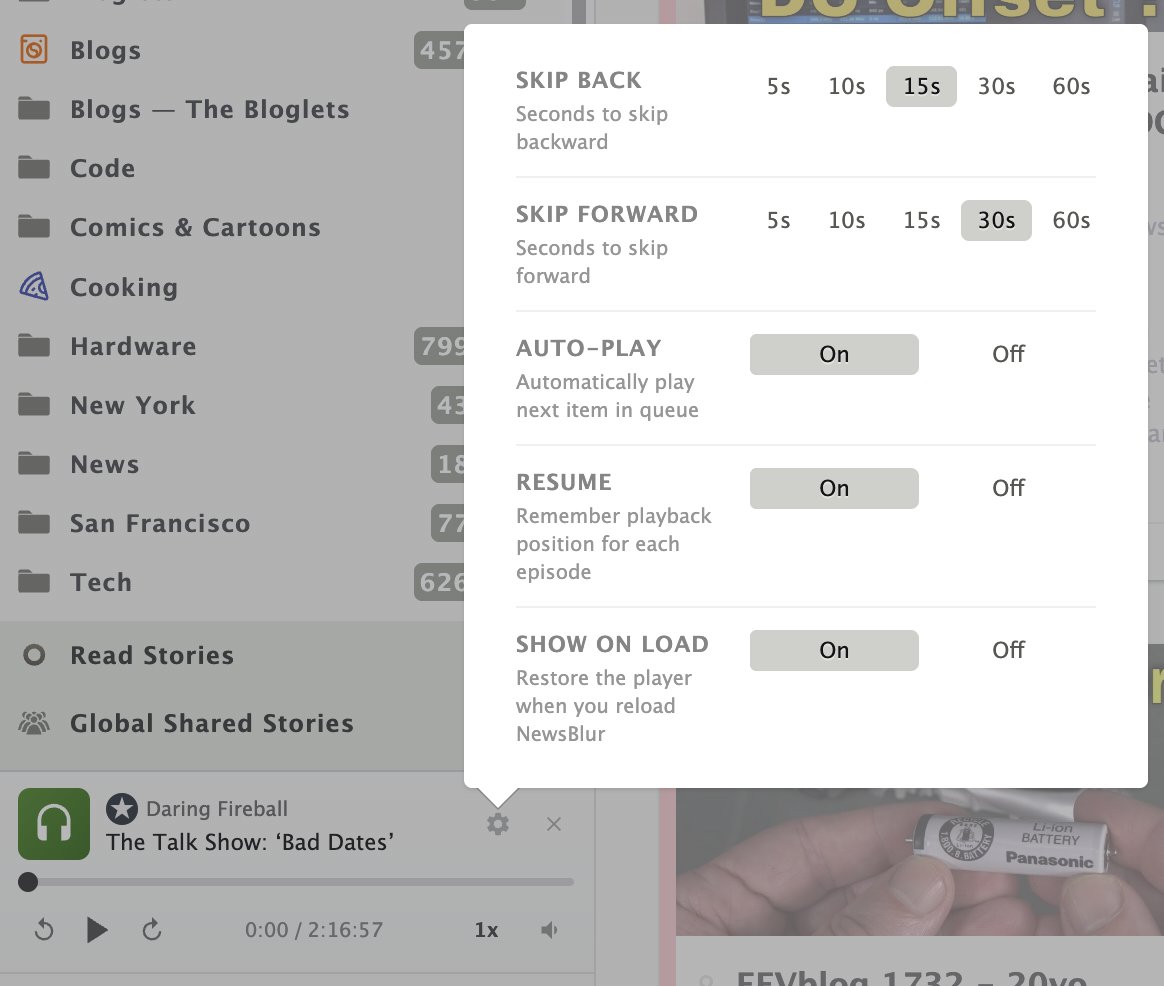
- Skip back/forward: Choose how far to jump (5s, 10s, 15s, 30s, or 60s in each direction)
- Auto-play: Automatically play the next queued item when the current one finishes (on by default)
- Resume position: Remember where you left off in each episode (on by default)
- Show on load: Restore the player when you reload NewsBlur, so you can pick up right where you left off (on by default)
Synced across reloads
Your playback state, queue, history, and settings are all saved to your NewsBlur account. Reload the page and the player comes back with your queue intact and the current episode paused where you left it. Position data syncs in real time via WebSocket so there’s no lag.
Playback speed
Click the speed indicator (next to the time display) to cycle through speeds: 0.5x, 0.75x, 1x, 1.25x, 1.5x, 2x, and 3x. Your speed preference is saved and applied to the next item in your queue automatically.
The mini media player is available now on the web for all NewsBlur users. If you have feedback or ideas for how to make it better, please share them on the NewsBlur forum.
-
Until now, the Intelligence Trainer was strictly per-feed. Train a title, author, or tag on one site and it only affected that site. If you wanted to hide a topic everywhere, you had to repeat that training on each feed. With a few feeds, that’s fine. With a hundred, it’s tedious. With five hundred, it’s a non-starter.
If you’re a Premium Archive subscriber, you can now set any classifier to apply globally across all your feeds, or scoped to a specific folder. Train “sponsored” as a dislike once, and it hides sponsored stories everywhere. Train “kubernetes” as a like in your Tech folder, and it highlights kubernetes stories across every feed in that folder without touching the rest of your subscriptions.
Three scope levels
Every classifier pill in the Intelligence Trainer now shows three small scope icons on the left: a feed icon, a folder icon, and a globe icon.
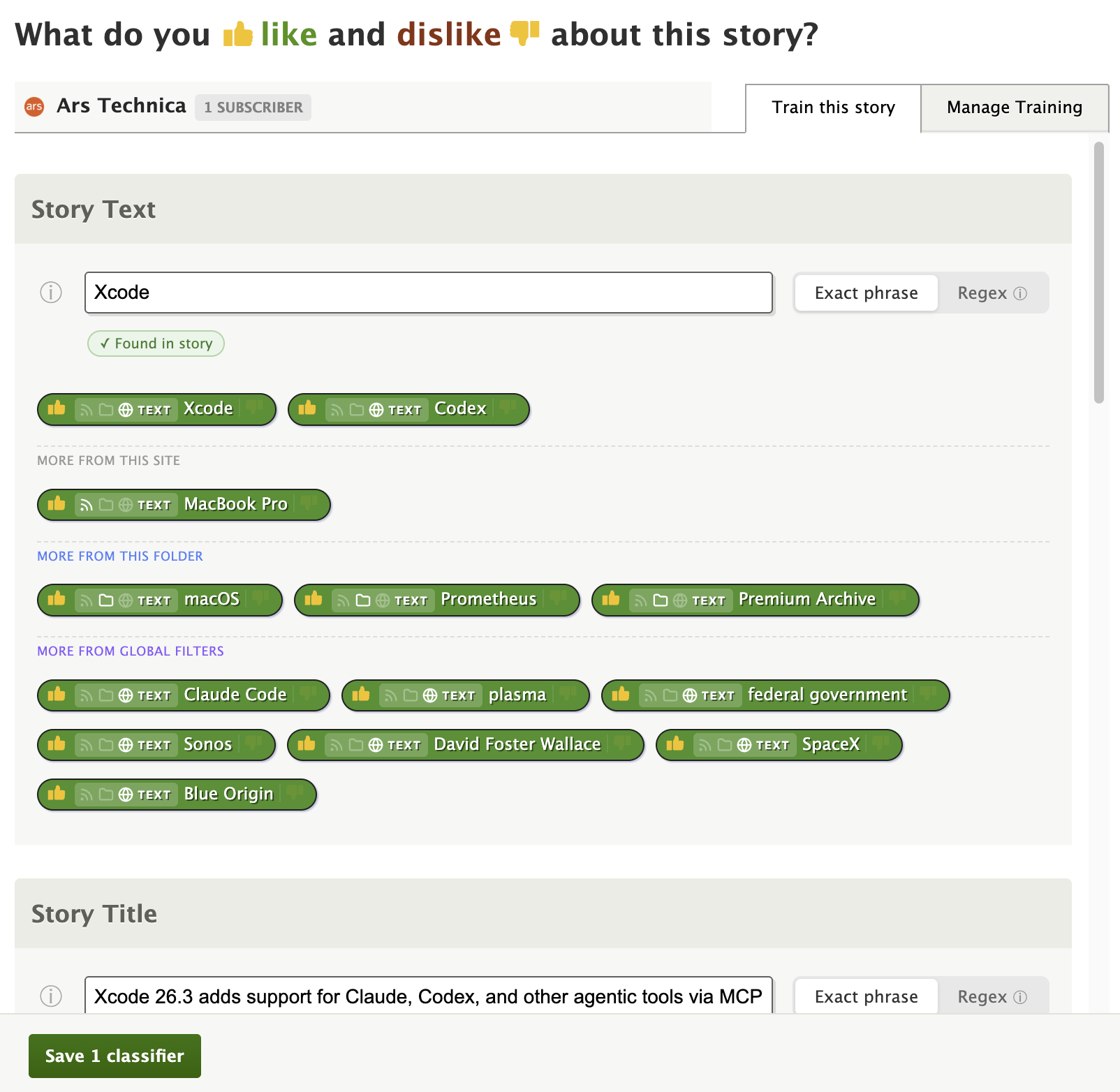
- Per Site (feed icon) — The default. The classifier only applies to the feed you’re training. This is how classifiers have always worked.
- Per Folder (folder icon) — The classifier applies to every feed in the same folder. If you later move the feed to a different folder, the classifier stays tied to the original folder.
- Global (globe icon) — The classifier applies to every feed you subscribe to.
Click any scope icon to switch. The active scope is highlighted, and a tooltip explains each level. Your choice is saved with the classifier.
Real-world examples
Hide a topic everywhere. Subscribe to lots of news feeds but never want to read about a recurring topic? Open the trainer on any feed, add the topic as a text or title classifier, thumbs-down it, and click the globe icon. Done — it’s hidden across all your feeds.
Focus on a topic within a folder. Have a “Tech” folder with 40 feeds? Train “machine learning” as a like with the folder scope, and every feed in that folder will surface machine learning stories in your Focus view. Your cooking and sports feeds stay untouched.
Dislike a prolific author. Some authors are syndicated across multiple sites. Instead of training the same author name on each feed, set it to global and it applies everywhere at once.
Manage Training scope filter
The Manage Training tab now includes a scope filter alongside the existing sentiment, type, and search filters. You can quickly see all your global classifiers, all your folder-scoped classifiers, or narrow down to just per-site training.
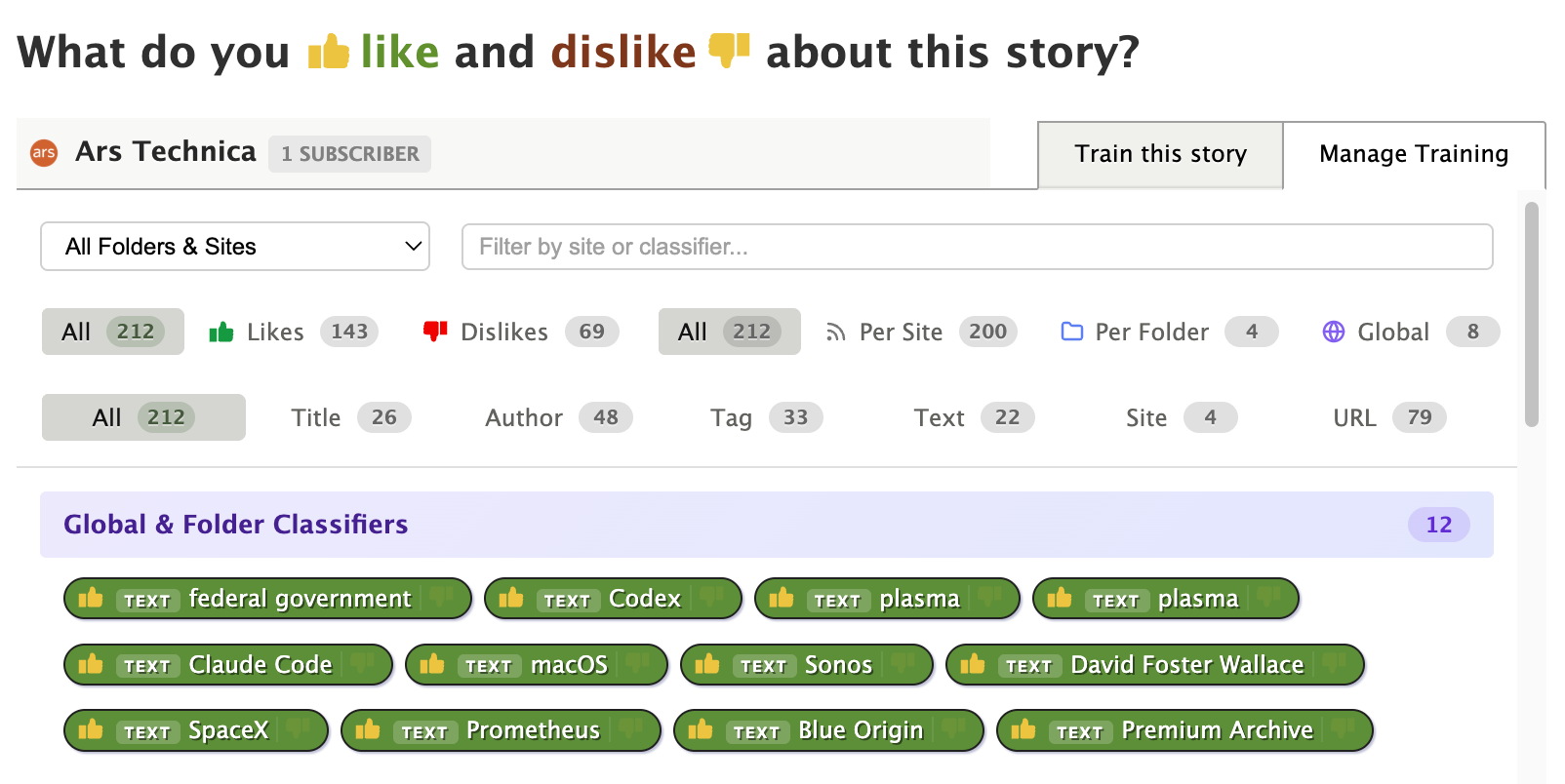
Each classifier pill in the Manage Training list also shows a small colored scope badge, so you can tell at a glance whether a classifier is site-level, folder-level, or global.
How scoping works under the hood
When NewsBlur scores a story, it checks all classifiers that apply to that story’s feed — including any folder-scoped classifiers for the feed’s folder and any global classifiers. The same “green always wins” rule applies: if a story matches both a liked global classifier and a disliked per-site classifier, the story is marked as Focus.
Scope controls work with all classifier types: titles, authors, tags, text, and URLs. They also work with regex classifiers.
Subscription tiers
Feature Tier Required Per-site classifiers (default) Free Global and folder-scoped classifiers Premium Archive Manage Training scope filter Premium Archive Global and folder-scoped classifiers are available now on the web. If you have feedback or ideas for improvements, please share them on the NewsBlur forum.
-
Some feeds I want to read every single story. Others I’m happy to skim once a week. And a few high-volume feeds I only check occasionally, so stories older than a day or two aren’t worth catching up on. Premium Archive subscribers get the site-wide “days of unread” setting, but it was too blunt, applying the same rule to everything. Now you can set how long stories stay unread on a per-feed and per-folder basis.
How it works
Open the feed options popover (click the gear icon in the feed header) and you’ll see a new “Auto Mark as Read” section. Choose how many days stories should remain unread before NewsBlur automatically marks them as read:
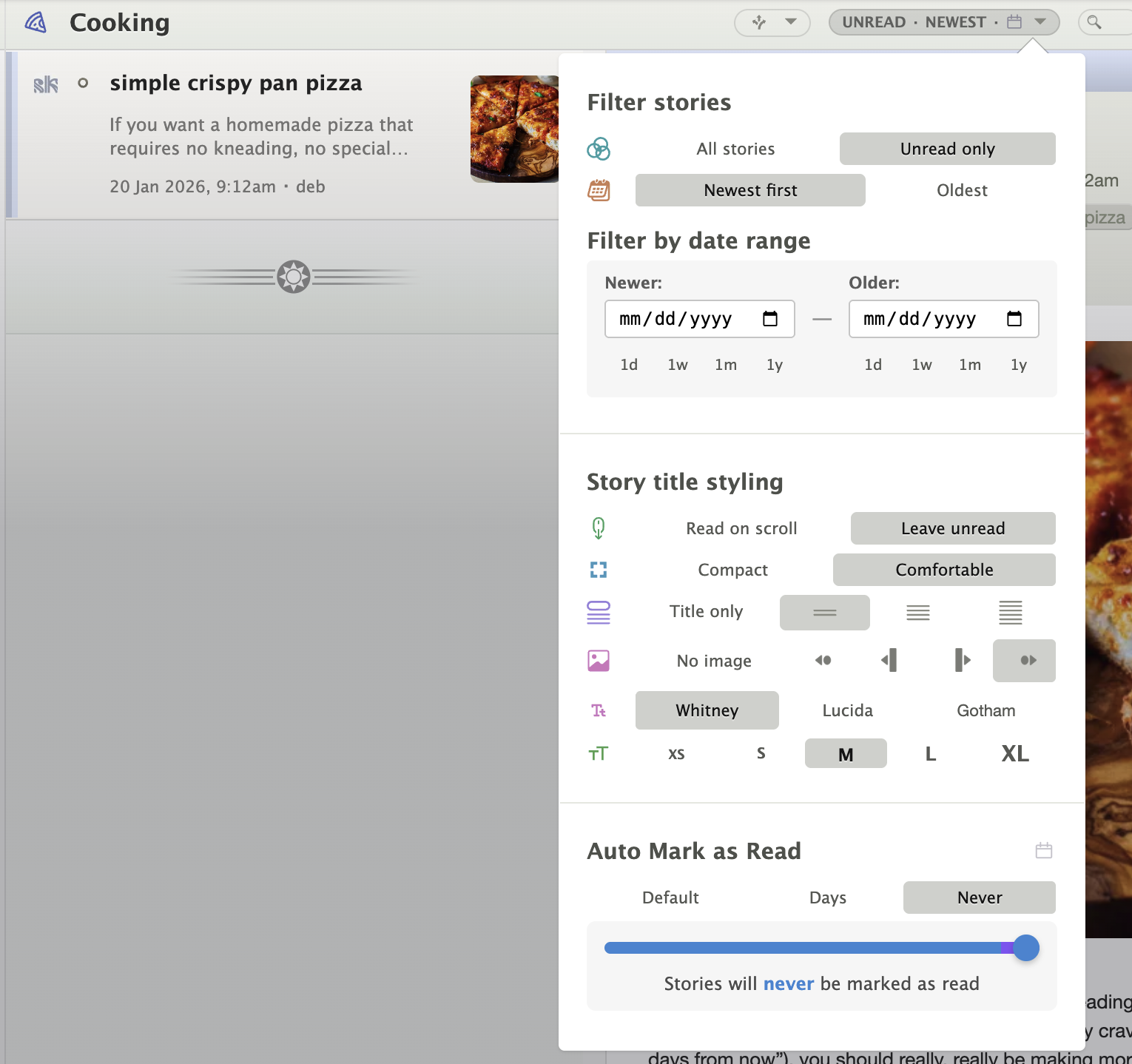
The slider goes from 1 day to 365 days, with a “never” zone at the far right for feeds where you truly want to read every story regardless of age. Choose “Default” to inherit from the parent folder or site-wide setting, “Days” to set a specific duration, or “Never” to disable auto-marking entirely.
Folder inheritance
Settings cascade down from folders to feeds. Set a folder to 7 days, and all feeds inside inherit that setting unless they have their own override. This is perfect for organizing feeds by how aggressively you want to age them out:
- Must Read folder: Set to “Never” so nothing ages out
- News folder: Set to 2 days since news gets stale fast
- Blogs folder: Set to 30 days for long-form content worth revisiting
- Individual feeds can still override their folder’s setting
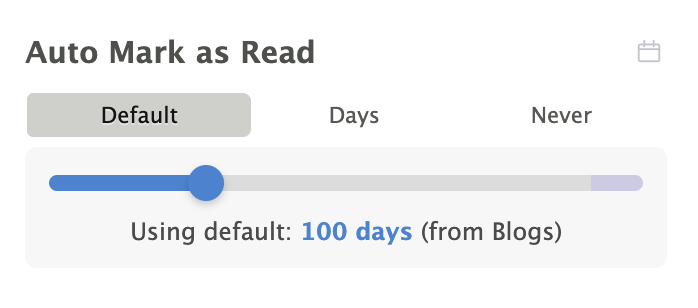
The status text below the slider shows where the current setting comes from: the site-wide preference, a parent folder, or an explicit setting on this feed.
Site settings dialog
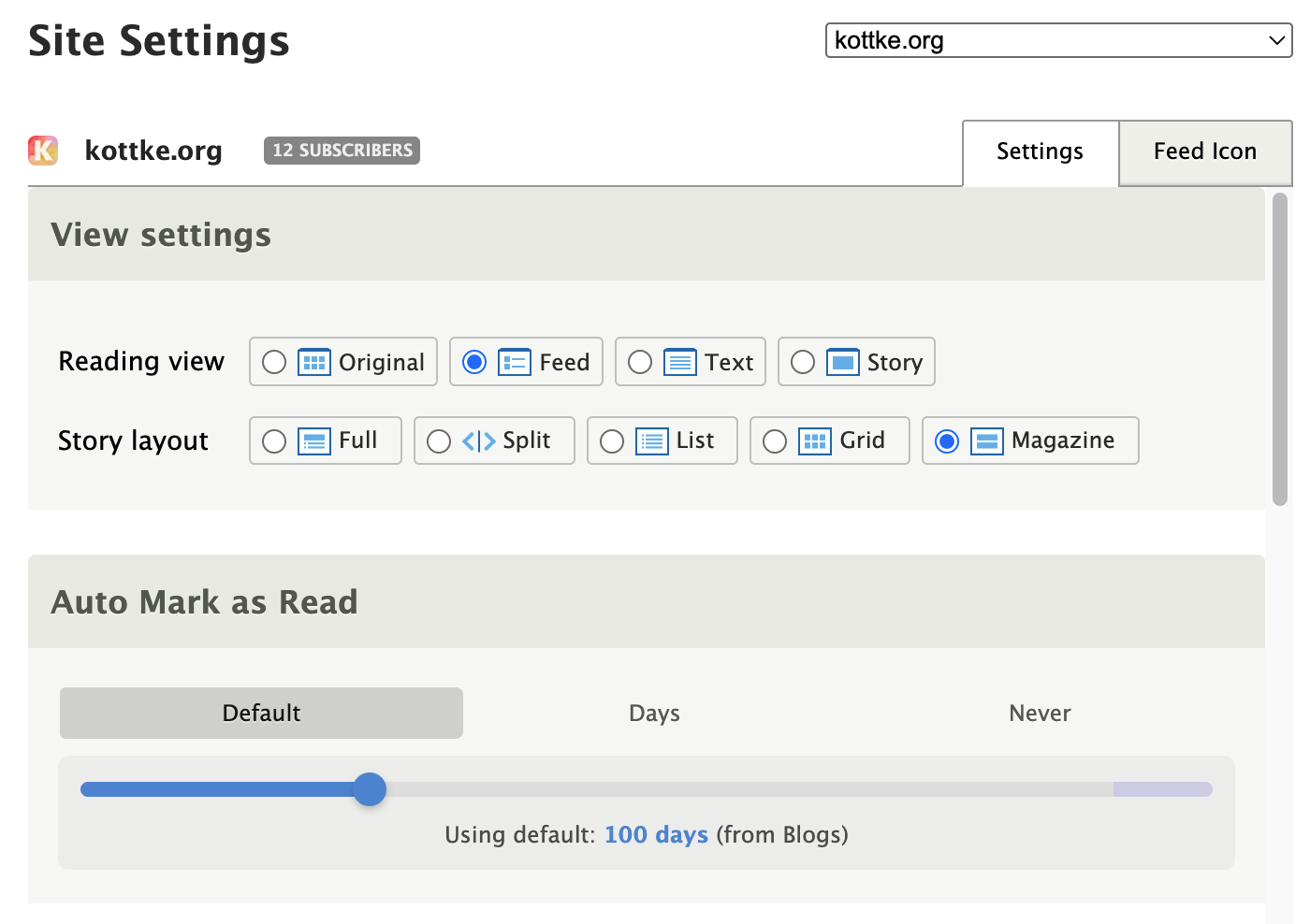
You can also configure auto-mark-read from the site settings dialog (right-click a feed and choose “Site settings”). The same controls are available there, redesigned to match the popover style.
Availability
Per-feed and per-folder auto-mark-as-read settings are a Premium Archive feature, available now on the web. They work alongside the existing site-wide “days of unread” preference in Manage → Preferences → General → Days of unreads, which is also a Premium Archive feature.
If you have feedback or ideas for improvements, please share them on the NewsBlur forum.
-
The Intelligence Trainer is one of NewsBlur’s most powerful features. It lets you train on authors, tags, titles, and text to automatically sort stories into Focus, Unread, or Hidden. But until now, there were limits—you couldn’t train on URLs, regex support was something power users had been requesting for years, and managing hundreds of classifiers meant clicking through feeds one by one.
Today I’m launching three major improvements: URL classifiers, regex mode for power users, and a completely redesigned Manage Training tab.
Train on URLs
You can now train on story permalink URLs, not just titles and content. This opens up new filtering possibilities based on URL patterns.
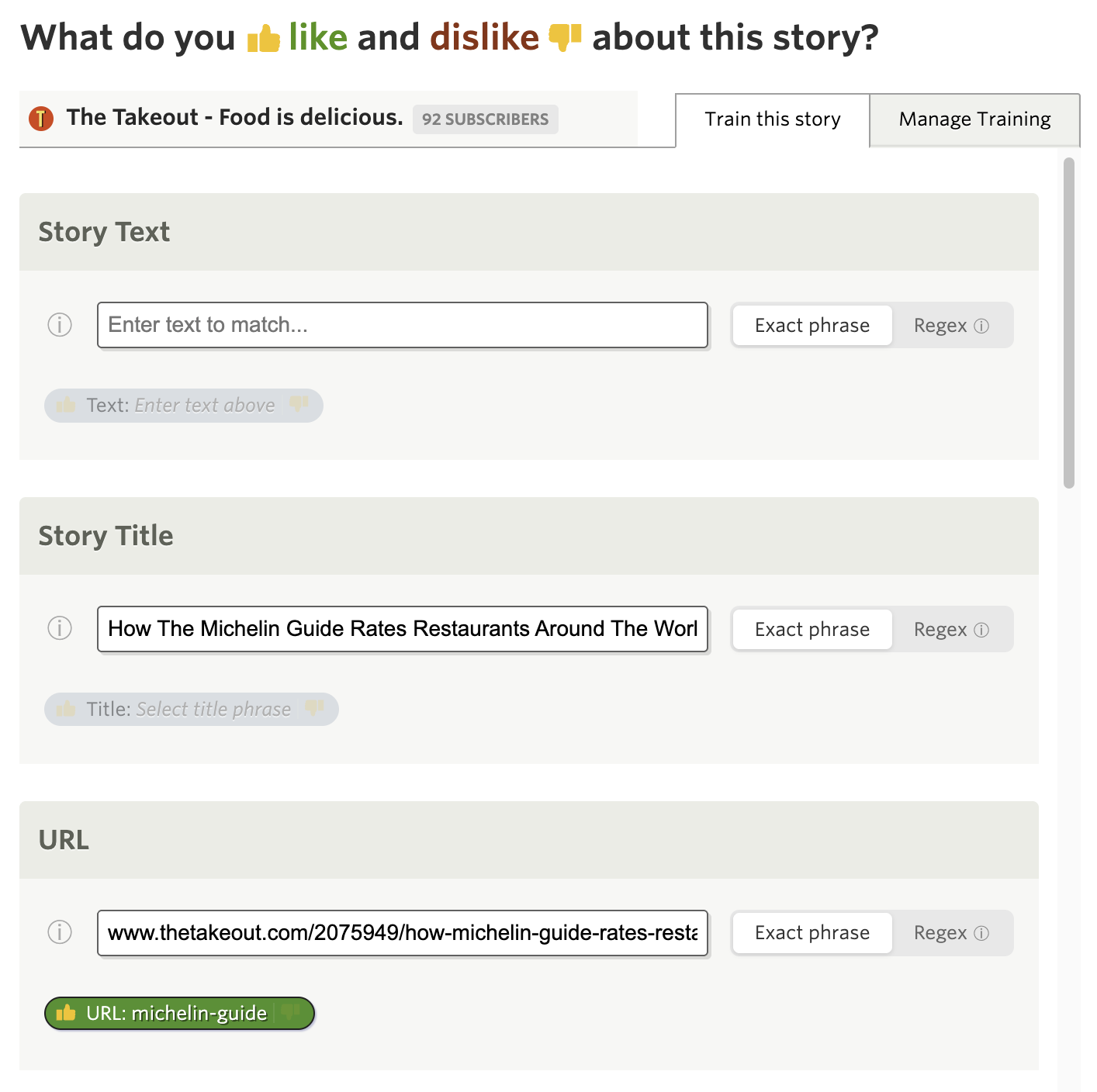
The URL classifier matches against the full story permalink. Some use cases:
- Filter by URL path: Like or dislike stories that contain
/sponsored/or/opinion/in their URL - Domain sections: Match specific subdomains or URL segments that indicate content types
- Landing pages vs articles: Some feeds include both—filter by URL structure to show only what you want
URL classifiers support both exact phrase matching and regex mode. The exact phrase match is available to Premium subscribers, while regex mode requires Premium Pro.
When a URL classifier matches, you’ll see the matched portion highlighted directly in the story header, so you always know why a story was filtered.
Regex matching for power users
For years, the text classifier only supported exact phrase matching. If you wanted to match “iPhone” and “iPad” you needed two separate classifiers. Now you can use regex patterns in the Title, Text, and URL classifiers.
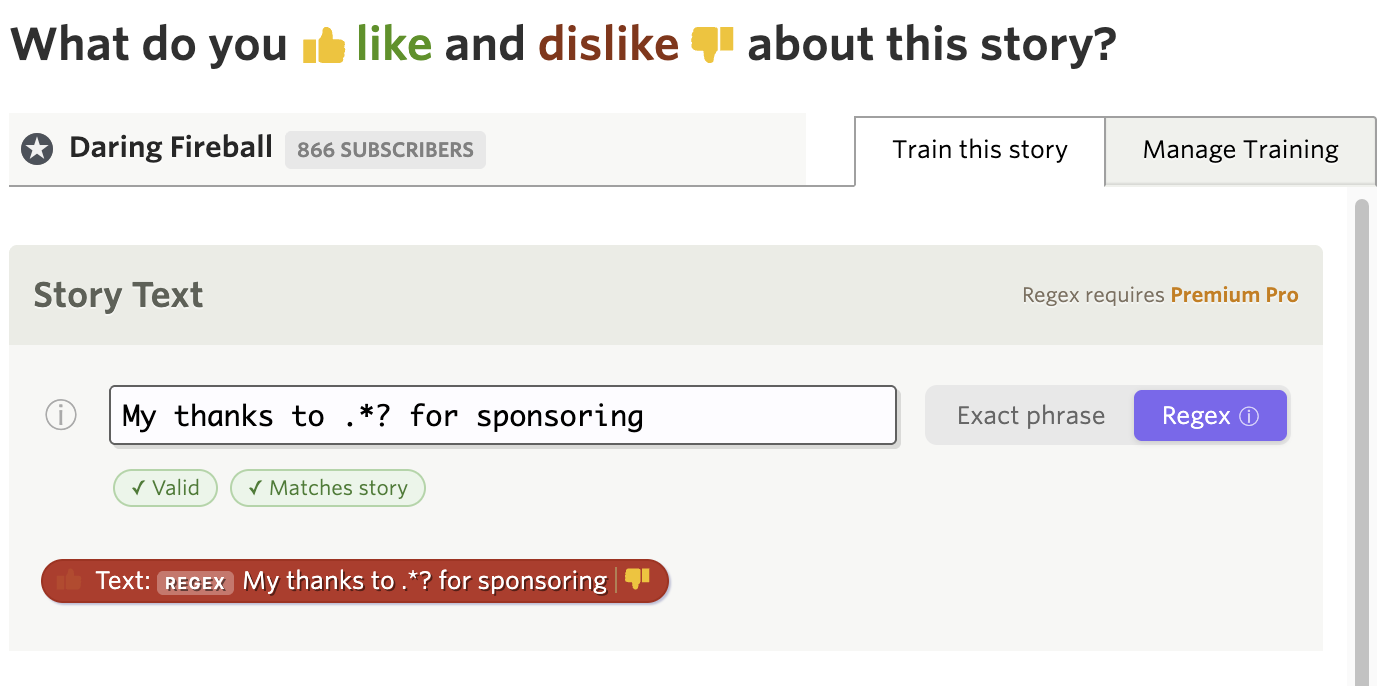
A segmented control lets you switch between “Exact phrase” and “Regex” mode. In regex mode, you get access to the full power of regular expressions:
- Word boundaries (
\b): Match\bapple\bto find “apple” but not “pineapple” - Alternation (
|): MatchiPhone|iPad|Macin a single classifier - Optional characters (
?): Matchcolou?rto find both “color” and “colour” - Anchors (
^and$): Match patterns at the start or end of text - Character classes: Match
[0-9]+for any number sequence
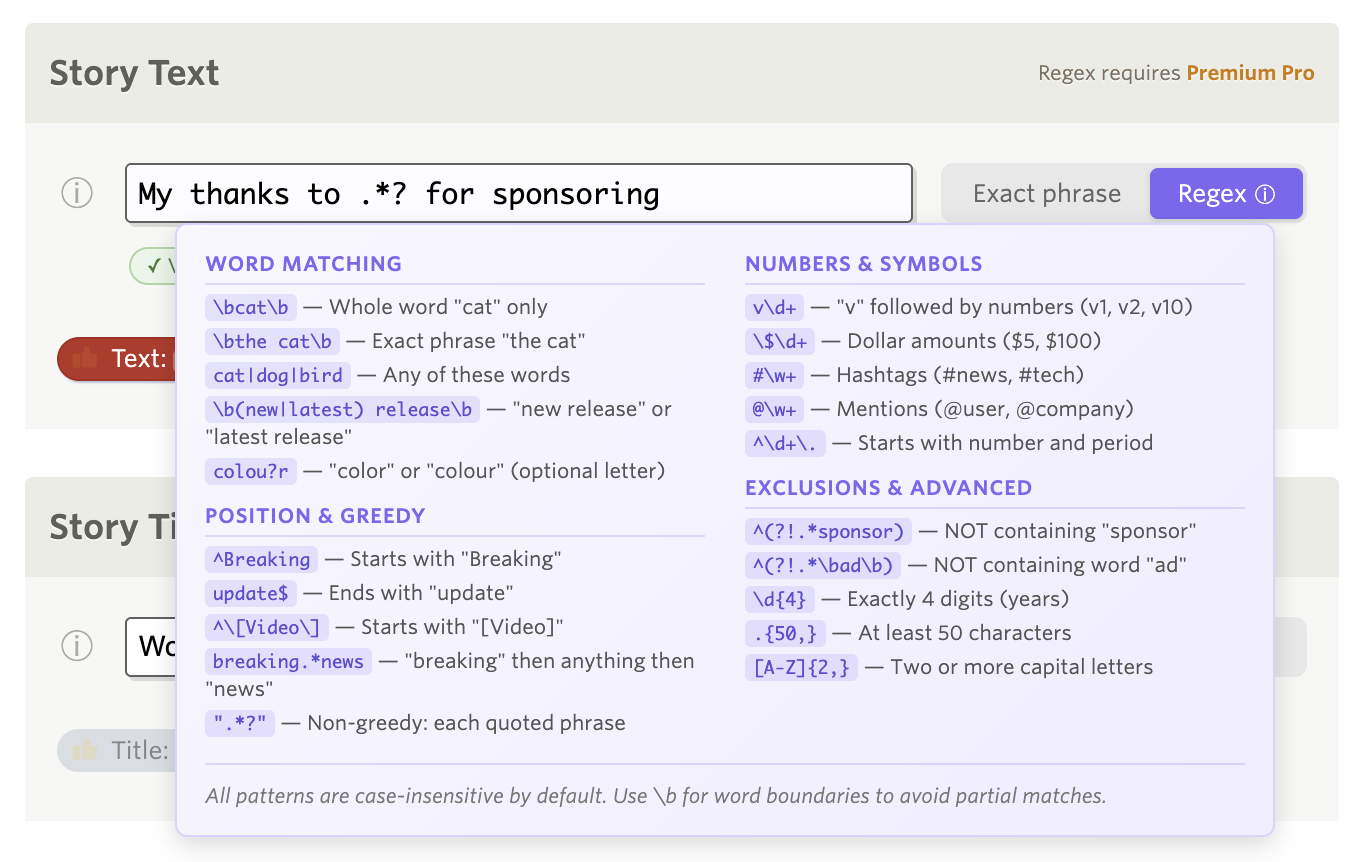
A built-in help popover explains regex syntax with practical examples. The trainer validates your regex in real-time and shows helpful error messages if the pattern is invalid.
Regex matching is case-insensitive, so
applematches “Apple”, “APPLE”, and “apple”. This mode is available to Premium Pro subscribers.Manage all your training in one place
Over the years you may have trained NewsBlur on hundreds of authors, tags, and titles across dozens of feeds. But when you wanted to review what you’d trained, you had to open each feed’s trainer individually and click through them one by one.
The new Manage Training tab provides a consolidated view of every classifier you’ve ever trained, organized by folder. You can see everything at a glance, edit inline, and save changes across multiple feeds in a single click.
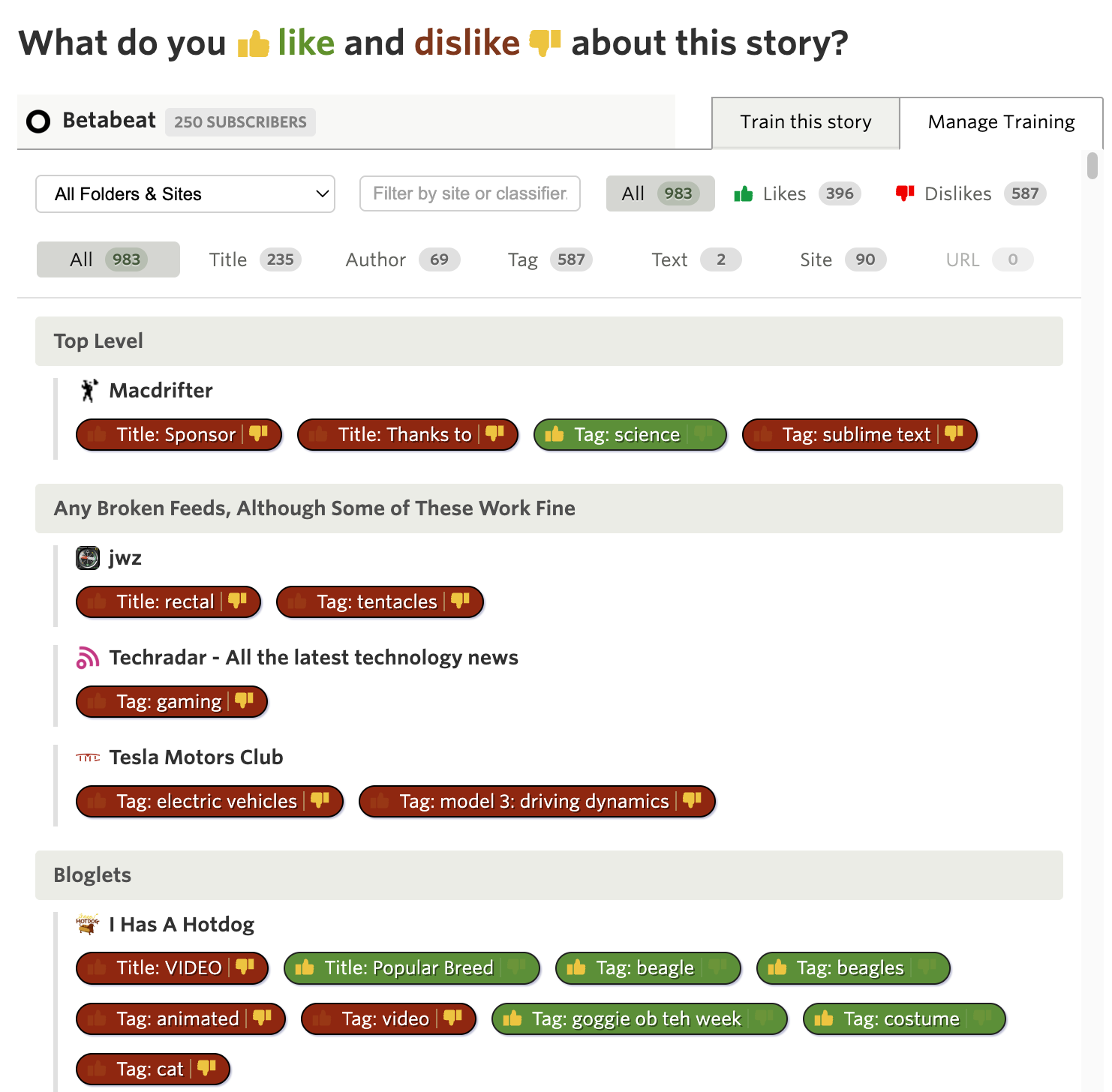
Open the Intelligence Trainer from the sidebar menu (or press the
tkey). You’ll now see two tabs at the top: “Site by Site” and “Manage Training”. The Manage Training tab is available everywhere you train—from the story trainer, feed trainer, or the main Intelligence Trainer dialog.The Site by Site tab is the existing trainer you know—it walks you through each feed showing authors, tags, and titles you can train. That’s still the best way to train new feeds with lots of suggestions.
The Manage Training tab shows only what you’ve already trained. Every thumbs up and thumbs down you’ve ever given, organized by folder just like your feed list. Each feed shows its trained classifiers as pills you can click to toggle.
Filtering made easy
The real power comes from the filtering options. At the top of the tab you’ll find several ways to narrow down your training:
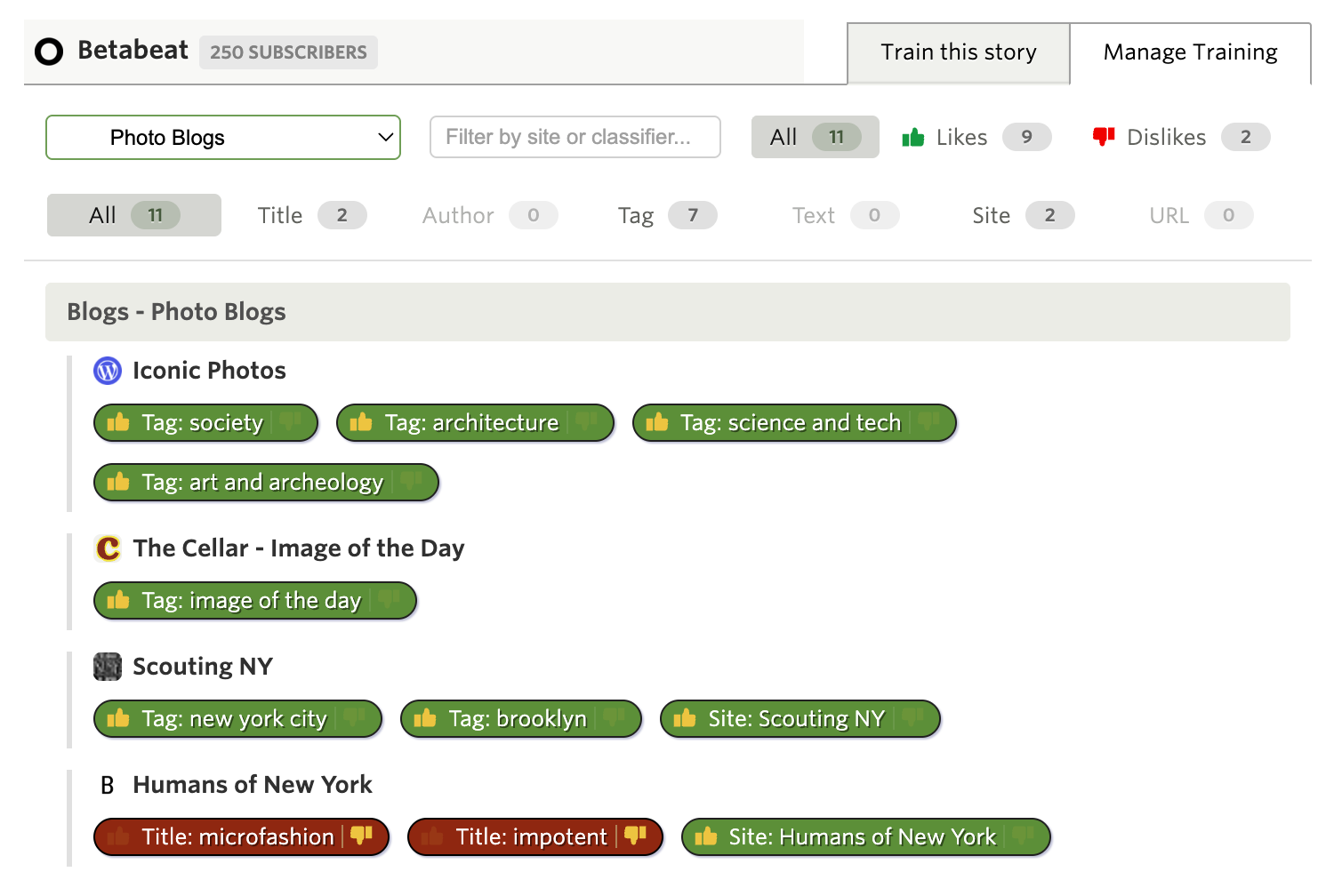
Folder/Site dropdown — Only folders and sites with training appear in this dropdown. Select a folder to see all training within it, or select a specific site to focus on just that feed’s classifiers. This is especially useful when you have hundreds of trained items and want to review just one area.
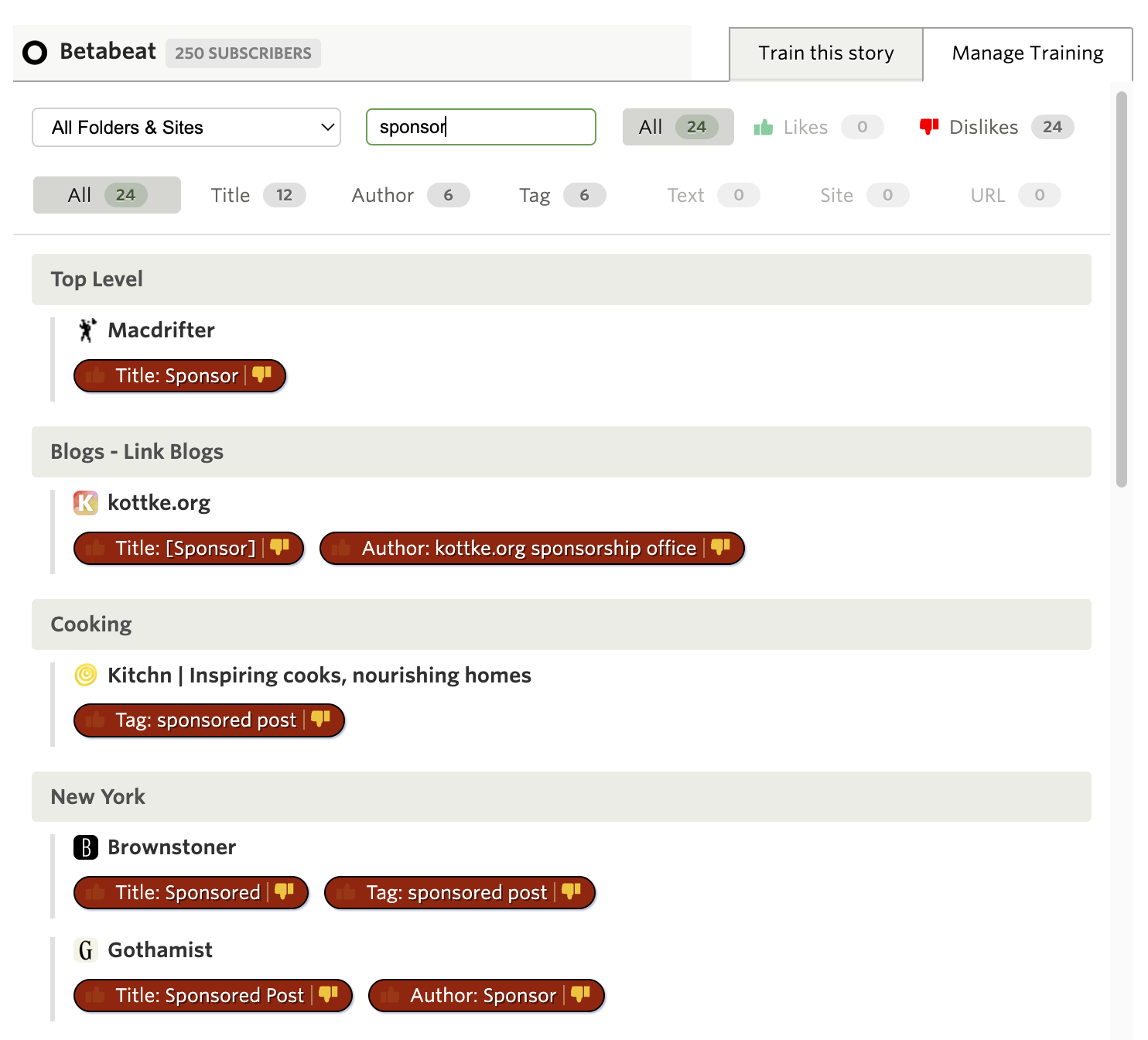
Instant search — Type in the search box and results filter as you type. Search matches against classifier names, feed titles, and folder names. Looking for everything you’ve trained about “apple”? Just type it and see all matches instantly.
Likes and Dislikes — Toggle between All, Likes only, or Dislikes only. Want to see everything you’ve marked as disliked? One click shows you all the red thumbs-down items across your entire training history.
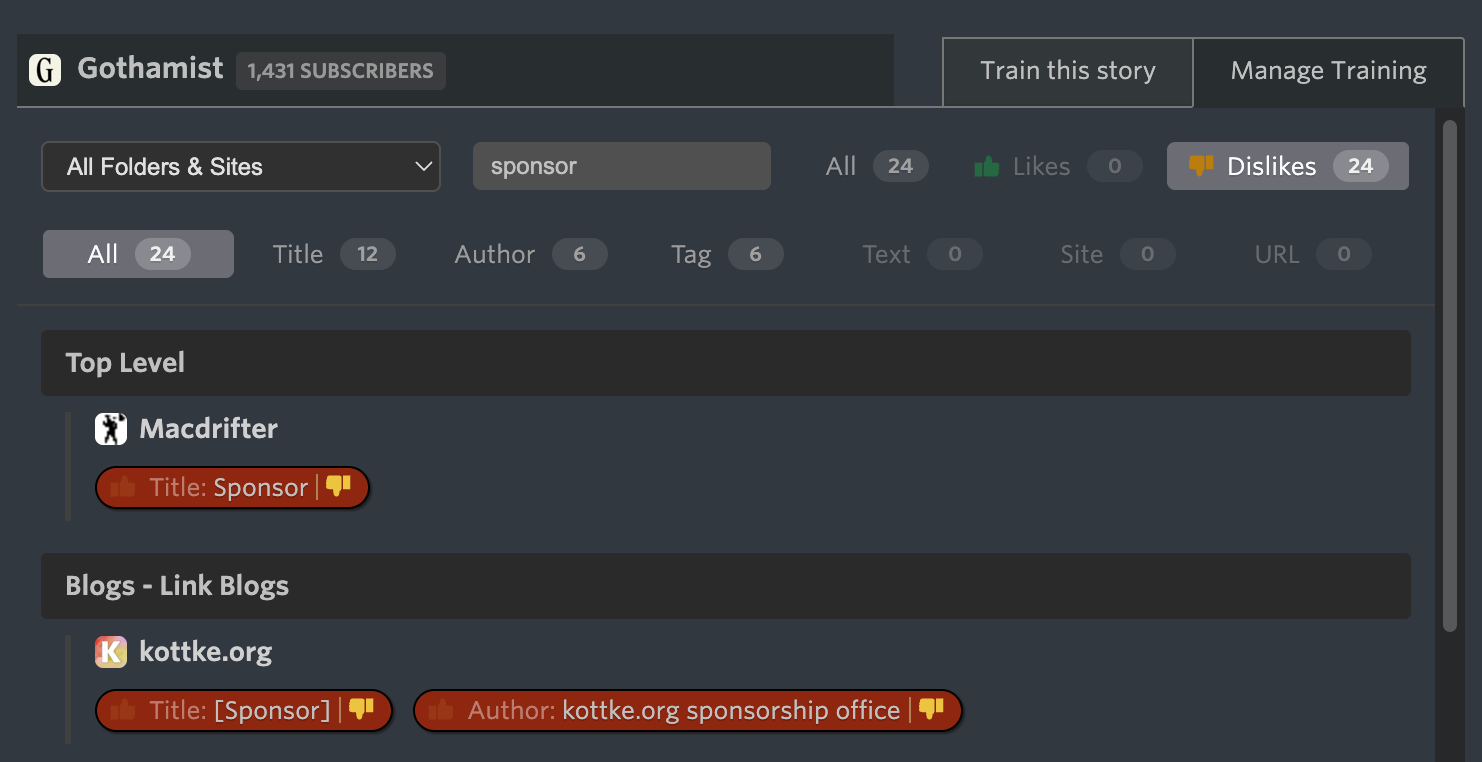
Type filters — Filter by classifier type: Title, Author, Tag, Text, URL, or Site. These are multi-select, so you can show just Authors and Tags while hiding everything else. Perfect for when you want to audit just the authors you’ve trained across all your feeds.
Edit inline and save in bulk
Click any classifier pill to toggle it between like, dislike, and neutral. The Save button shows exactly how many changes you’ve made, so you always know what’s pending. Made a mistake? Just click again to undo—the count updates automatically.
When you click Save, all your changes across all feeds are saved in a single request. No more clicking through feeds one at a time to clean up old training.
Subscription tiers
Feature Tier Required Title/Author/Tag/Feed classifiers Free Manage Training tab Free URL classifiers (exact phrase) Premium Text classifiers (exact phrase) Premium Archive Regex mode (Title, Text, URL) Premium Pro All three features are available now on the web. If you have feedback or ideas for improvements, please share them on the NewsBlur forum.
- Filter by URL path: Like or dislike stories that contain
-
Sometimes I open a story and realize I’m late to the party. Maybe it’s the fourth article in a saga I haven’t followed, maybe it name-drops people I should know, or maybe it’s dense and I just want the gist. Ask AI fills in those gaps. You can ask about any story in NewsBlur and get quick answers from the model you prefer.
How it works
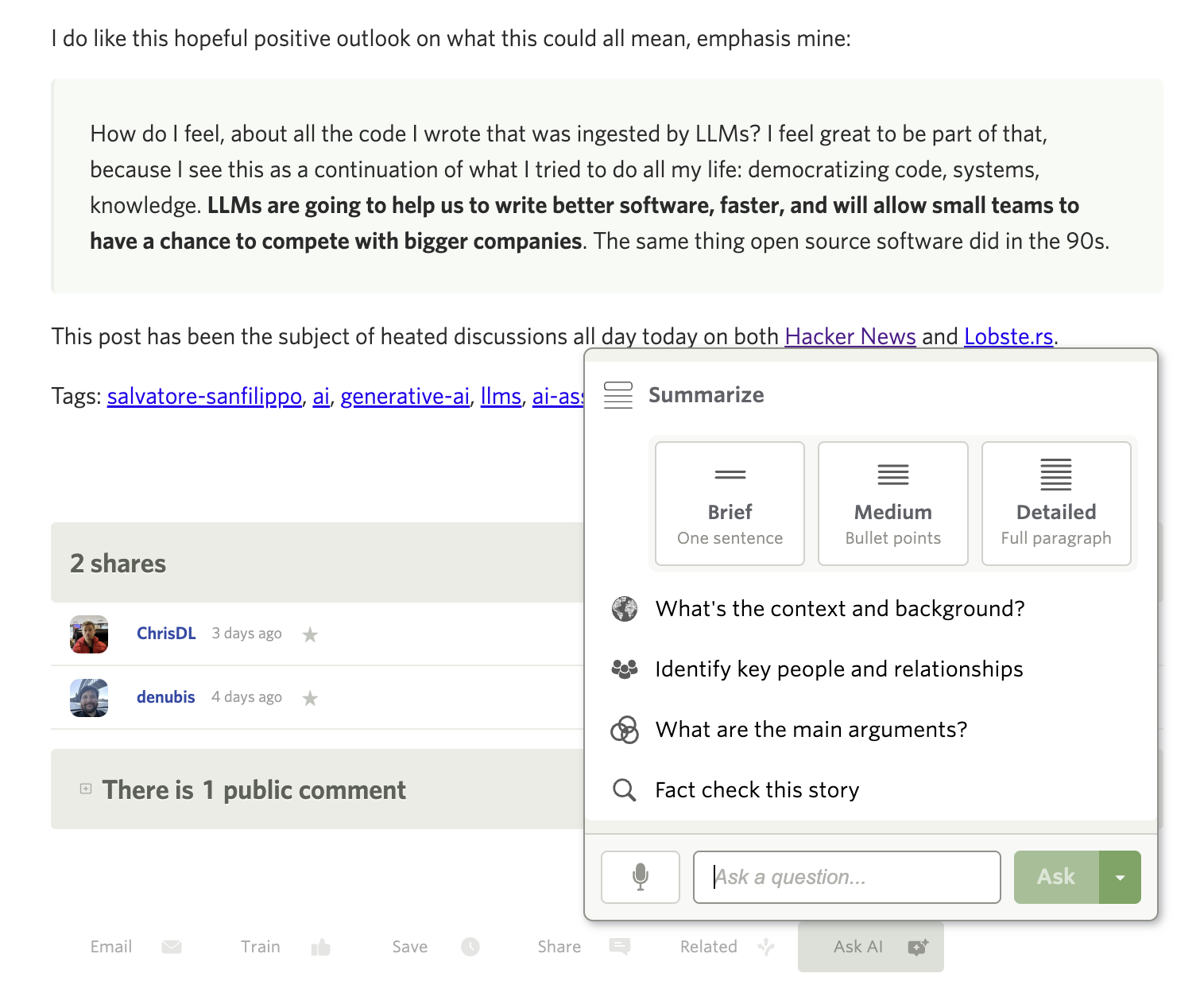
Select a story and click Ask AI in the story toolbar. You’ll see quick options for getting information about the story.
Not interested? Turn it off
I know AI features aren’t for everyone. If you’d rather not see Ask AI at all, you can hide it completely. Go to Manage → Preferences → Stories and toggle off “Show Ask AI button.” The button disappears from your toolbar and you’ll never be bothered by it again. NewsBlur has always been about giving you control over your reading experience, and this is no different.
Presets for common questions
At the top of the menu, you can summarize the story in three flavors: a single sentence, bullet points, or a full paragraph. Below that are presets I use most often:
- What’s the context and background? — Fills in backstory you might have missed
- Identify key people and relationships — Who are all these names and how do they connect?
- What are the main arguments? — For opinion pieces or debates, cuts to what each side is saying
- Fact check this story — Flags claims that look worth verifying
Or just type whatever you’re curious about.
Speak your question
See that microphone button? Click it and say your question out loud. NewsBlur uses OpenAI’s Whisper to transcribe your voice, so you can keep reading without typing. Handy when you’re on the couch and don’t want to pull out the keyboard.
Pick your model
Different models have different strengths. NewsBlur lets you pick from:
- Claude Opus 4.5 — The default, most capable model from Anthropic
- GPT 5.2 — OpenAI’s latest
- Gemini 3 Pro — Google’s offering
- Grok 4.1 Fast — xAI’s speedy option
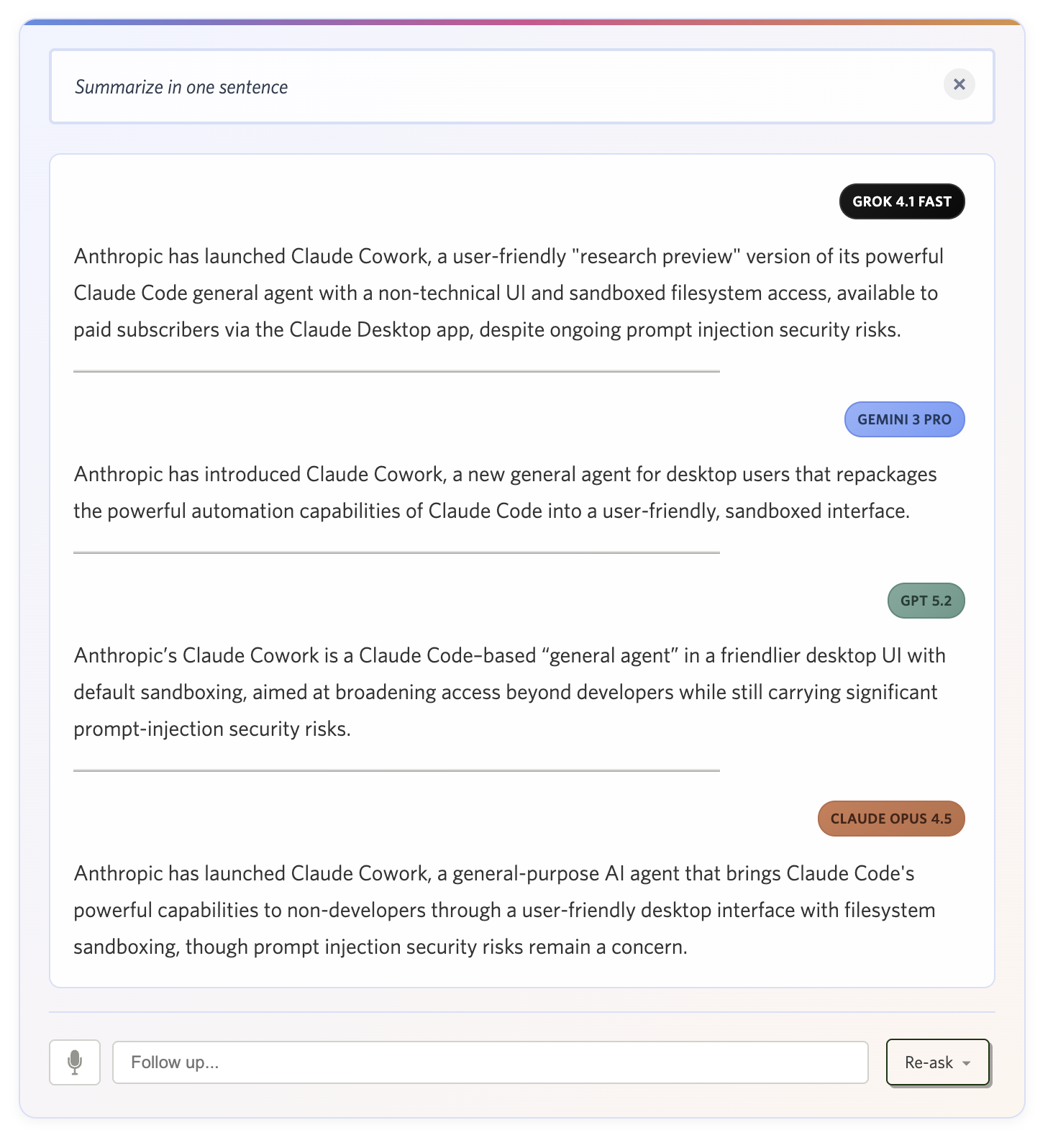
NewsBlur remembers your choice across sessions and devices. If a reply feels off, re-ask with a different model — they each have their own style.
Keep the conversation going
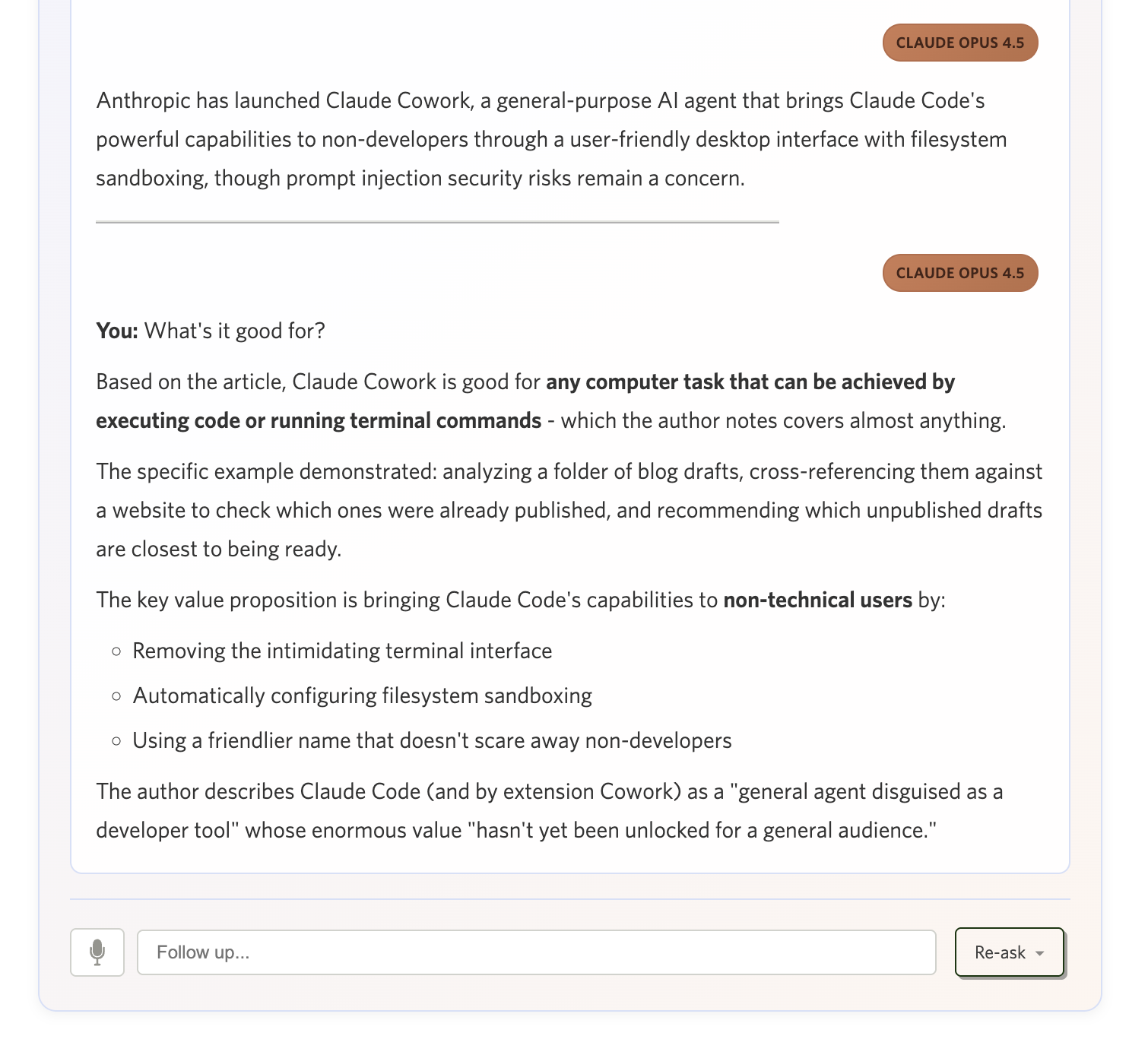
After the first answer, ask follow-ups. NewsBlur keeps the conversation context so you can dig deeper or ask for a clarification. It’s meant to be a back-and-forth, not a one-shot.
Your data stays yours
Your stories and questions are sent to the AI provider you choose to generate a response, but that’s it. NewsBlur doesn’t use your reading data or questions to train models or for any other purpose. The AI providers’ standard privacy policies apply, but NewsBlur itself treats your Ask AI usage the same as any other part of your reading experience — it’s your data, not ours.
Availability
Ask AI is live on the web. Here’s how many questions you get:
- Premium Archive: 100 questions per day
- Premium + Free: 1 question per week
Premium Archive limits reset daily at midnight in your local timezone. Premium and free limits reset weekly on Sunday.
If you’re not yet a Premium Archive subscriber, you can upgrade on the web to get the full Ask AI experience along with unlimited story archiving and full-text search.
As always, I’d love to hear what you think on the NewsBlur forum. If you have ideas for new preset questions or ways to make Ask AI more useful, let me know.
-
A common feature request over the years has been the ability to turn off NewsBlur’s social features entirely. For readers who just want to focus on their feeds without blurblogs, shared stories, or public comments, this is now possible with a single preference.
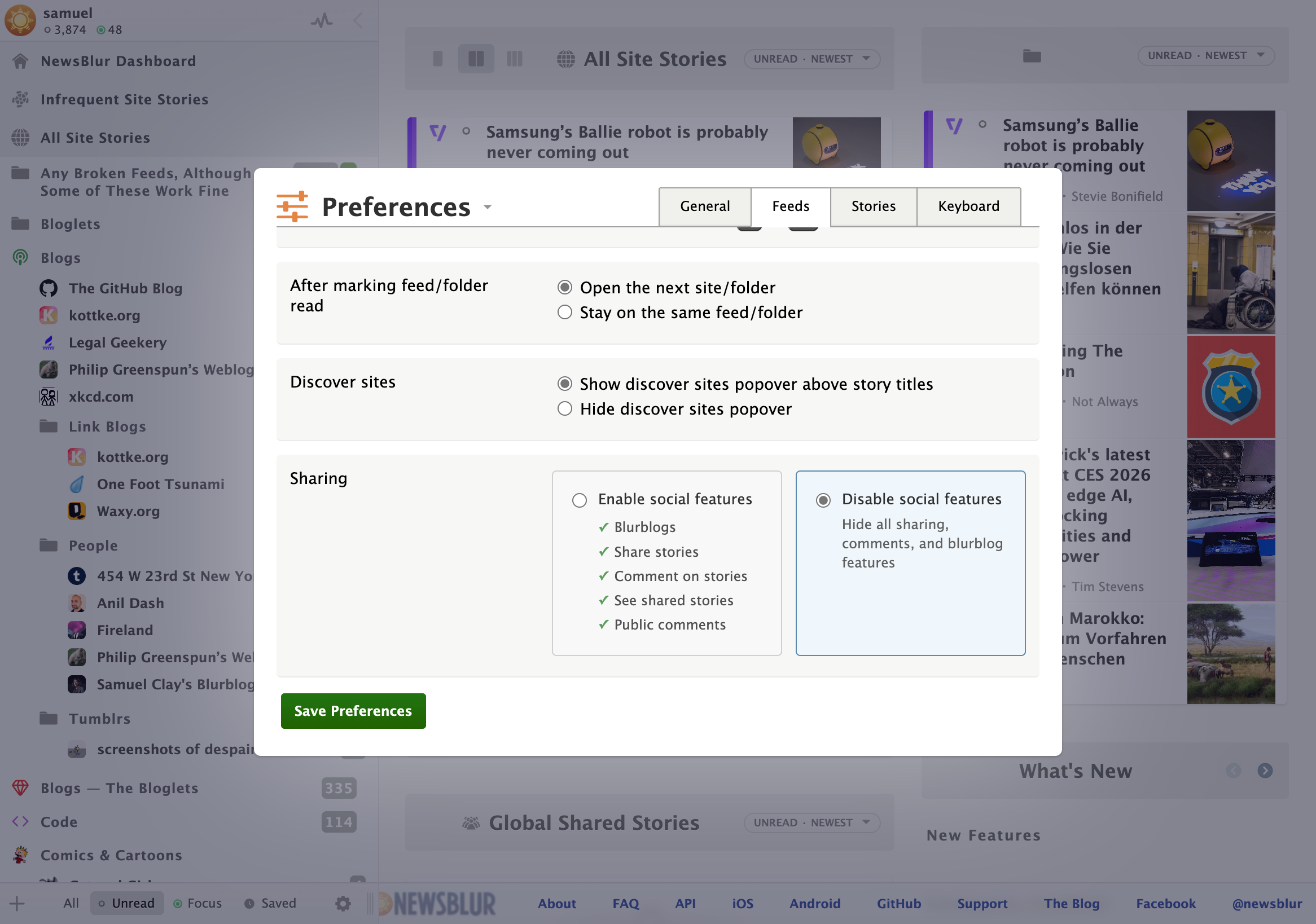
Head to Preferences > Feeds and look for the new “Sharing” option at the bottom. Choose “Disable social features” and all sharing, comments, and blurblog features will be hidden from your NewsBlur interface. The Global Shared Stories folder disappears, share buttons are removed from stories, and the sidebar is cleaned up. If you ever want to re-enable social features, just flip the preference back.
-
I have a lot of folders. Over the years I’ve organized my feeds into categories like News, Tech, Cooking, and Comics. But when I’m scanning my feed list, they all look the same—just folder icons with text. I wanted a way to make certain folders stand out at a glance, especially the ones I check most often.
That’s why I built custom icons for both folders and feeds. You can now personalize any folder or feed with an emoji, a preset icon in any color, or even upload your own image.
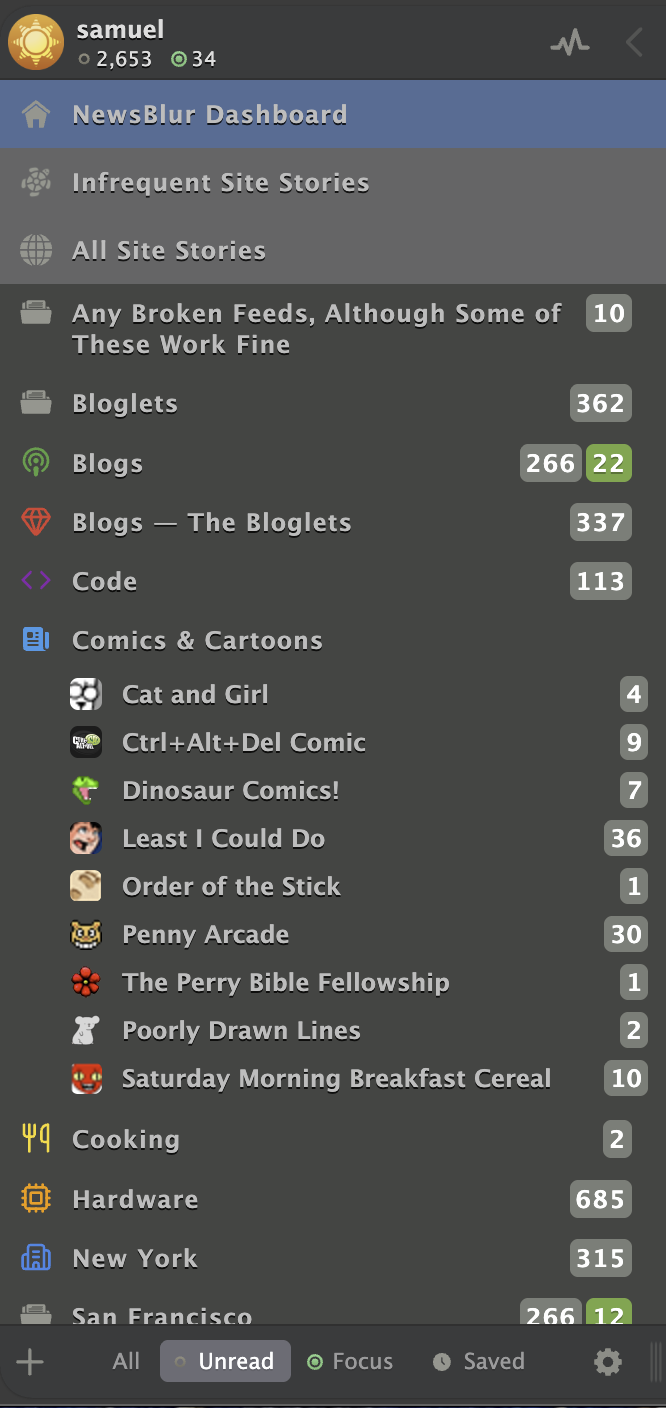
How it works
Right-click on any folder or feed in your feed list and select “Folder settings” or “Site settings”. You’ll see a new “Folder Icon” or “Feed Icon” tab where you can customize the icon.
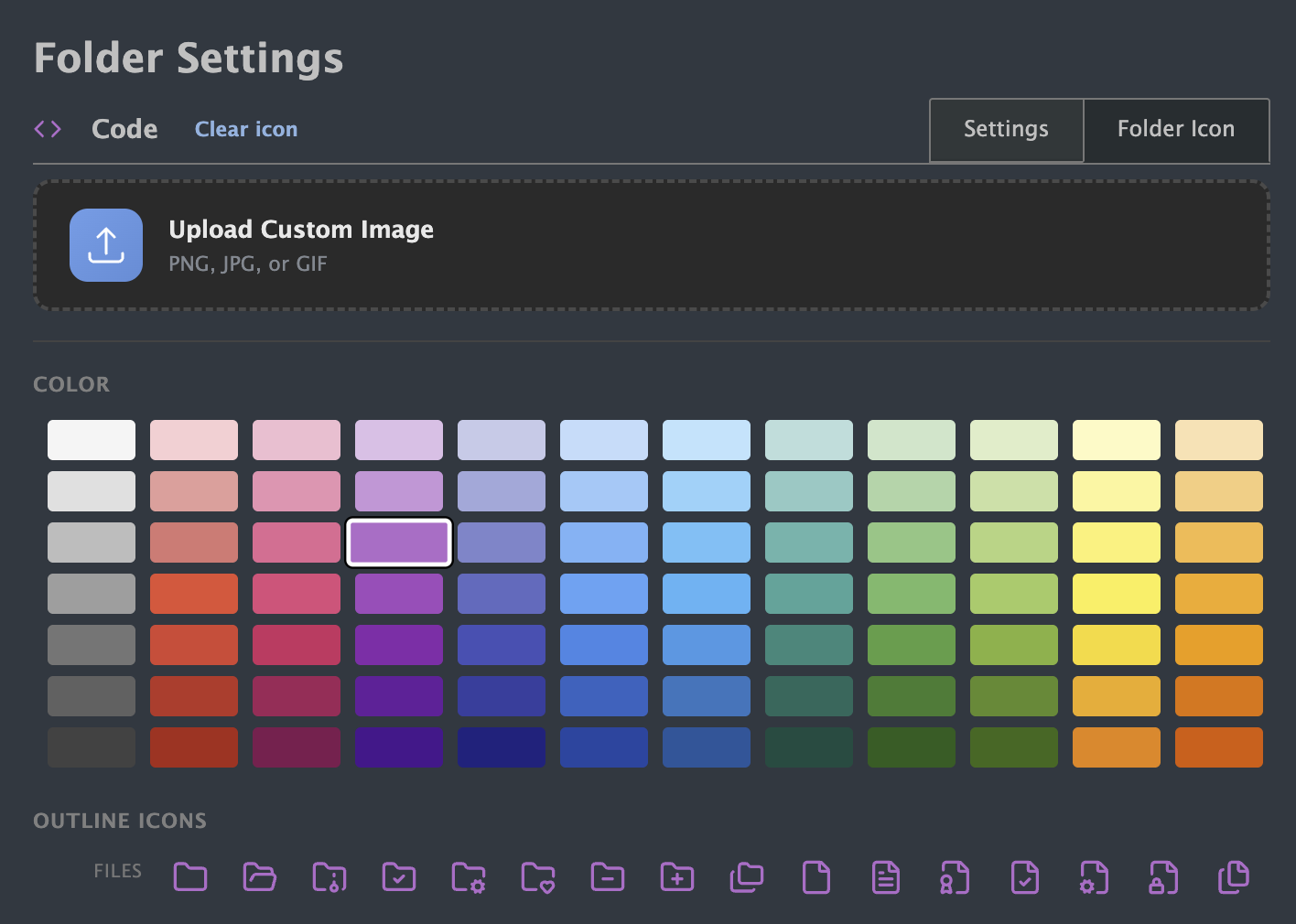
There are three ways to set a custom icon:
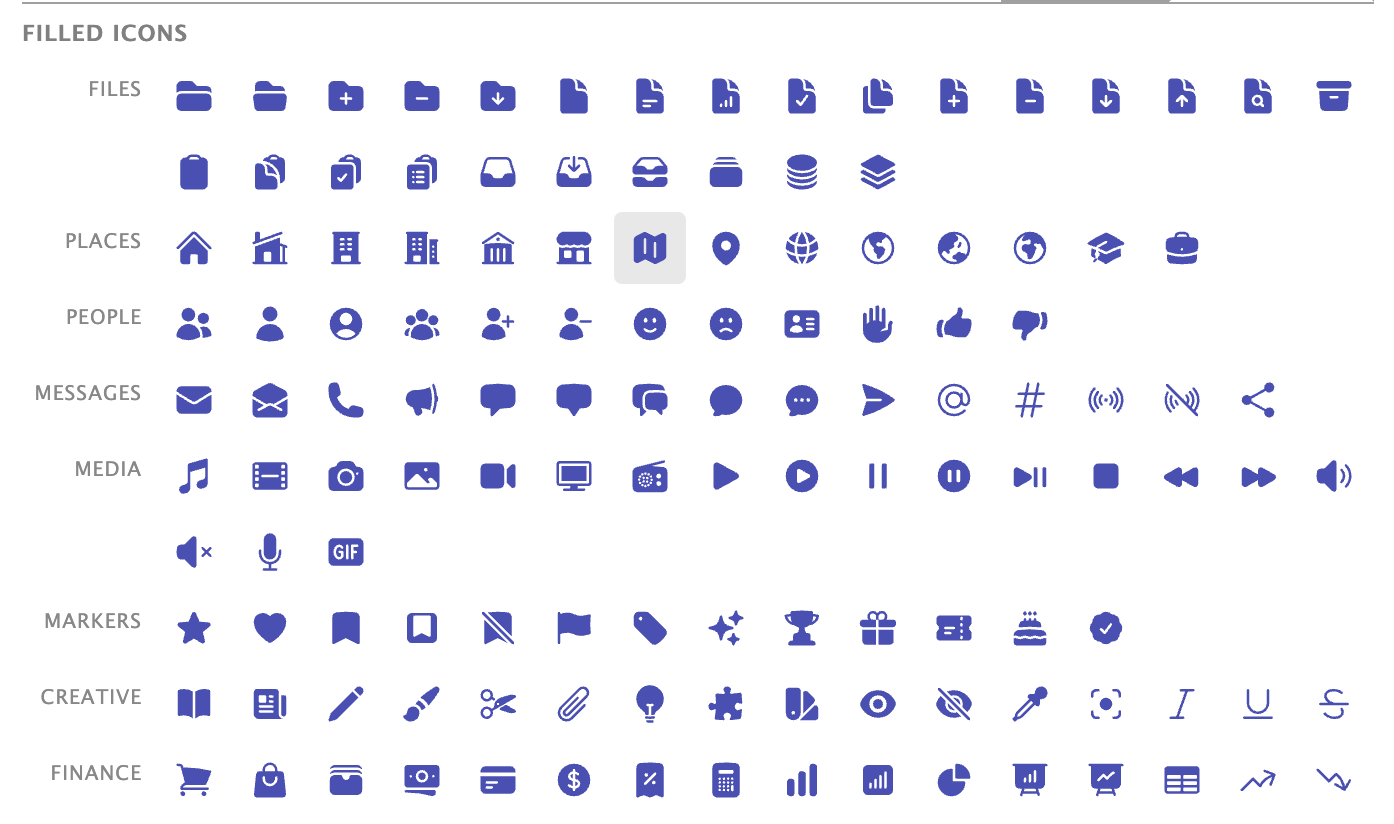
Preset icons: Pick from over 240 icons (a mix of outline and filled styles) and colorize them with any of 84 colors organized by hue. Want a red heart for your favorites folder? A blue code bracket for programming feeds? It’s all there.
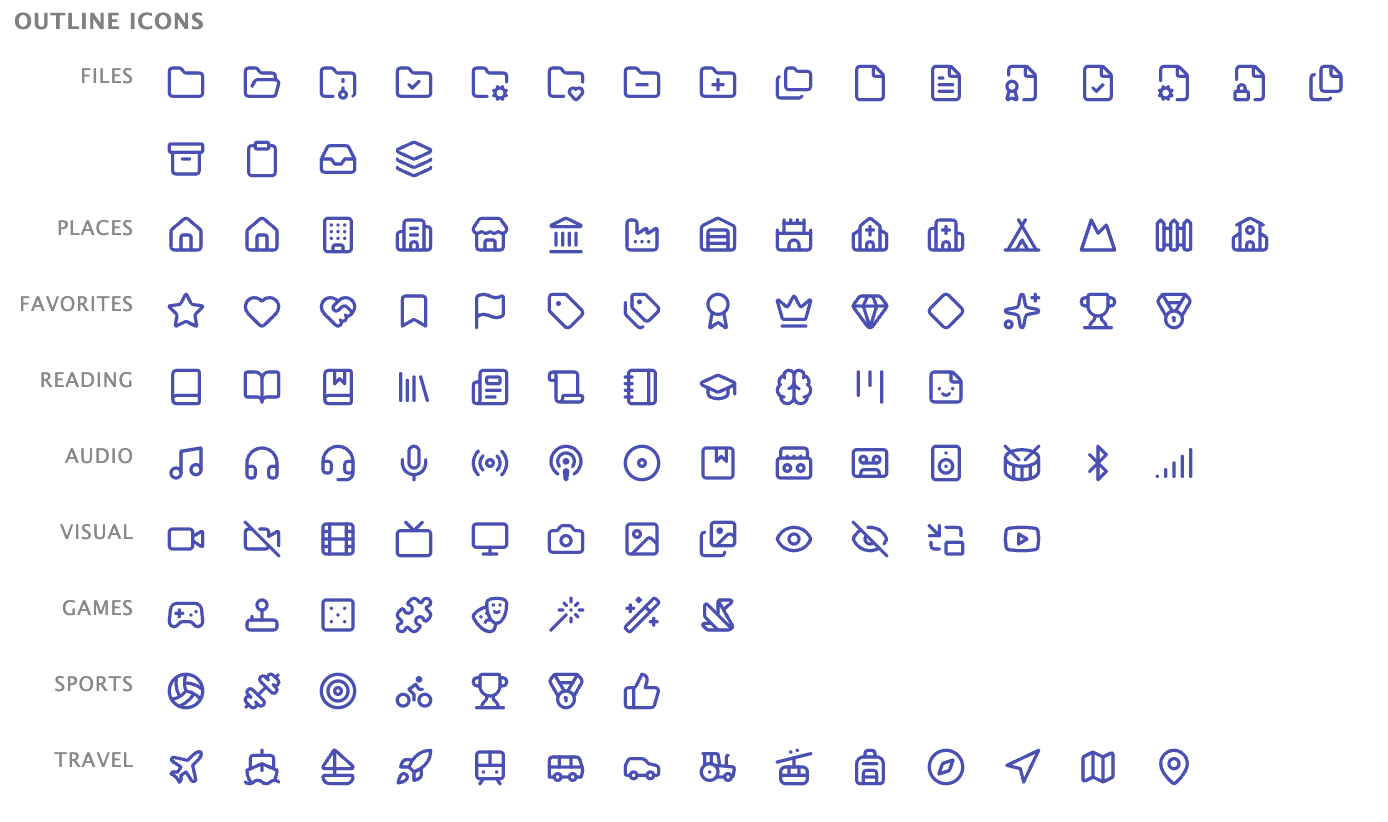
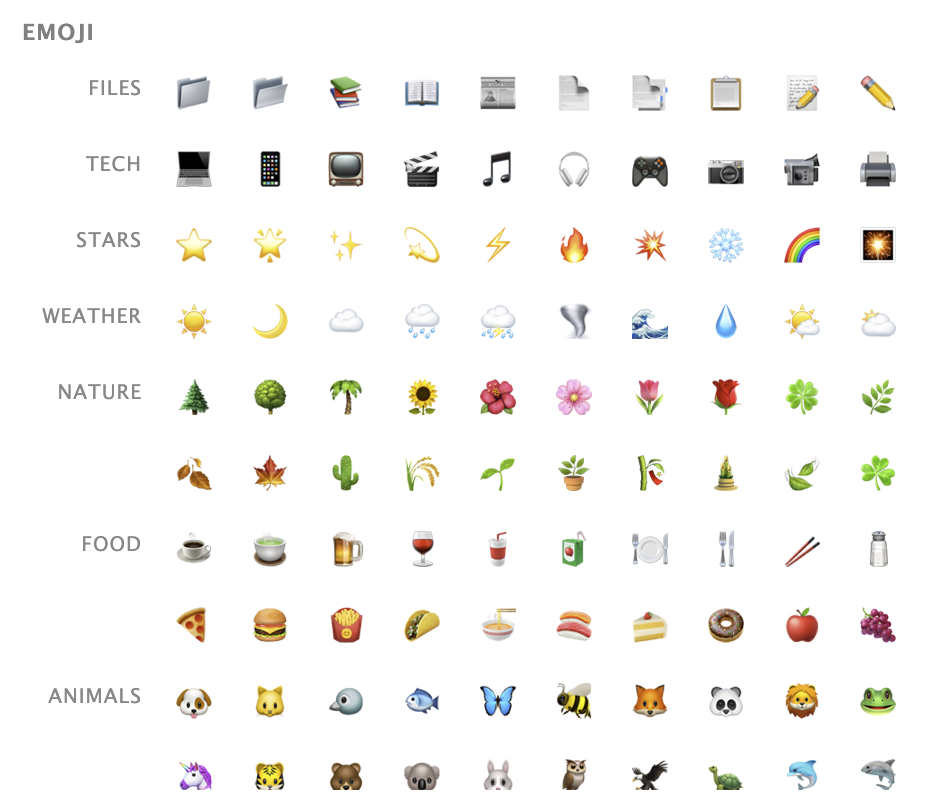
Emoji: Choose from 180 emojis organized by category. A basketball for sports feeds, a fork and knife for cooking, a newspaper for news—you get the idea.
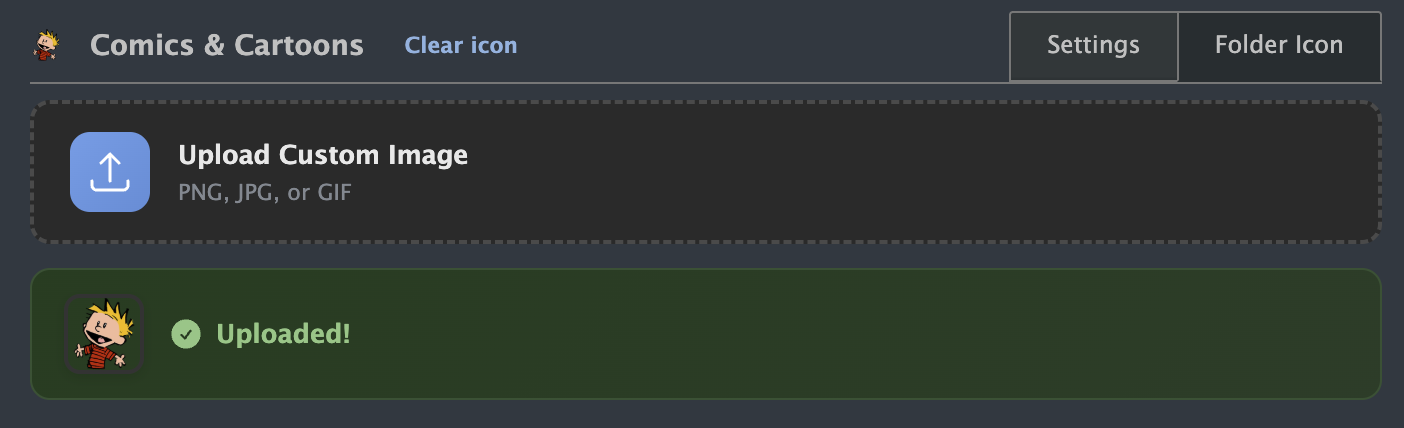
Upload your own: Have a specific image in mind? Upload any image and it will be automatically resized to fit perfectly in your feed list.
Great for feeds without icons
Many feeds don’t have favicons, or they have generic RSS icons that all look the same. Custom feed icons let you give these feeds distinctive icons so you can spot them instantly. I’ve been using this to add icons to older blogs and newsletters that never bothered setting up a proper favicon.
Custom icons are available now on the web for all NewsBlur users. Folders and feeds both support the same icon options of emoji, preset icons with colors, or uploaded images.
If you have feedback or ideas for additional icon options, please share them on the NewsBlur forum.
-
You can now automatically enable captions on YouTube videos embedded in your feeds. Head to Preferences > Stories and check the new “YouTube Captions” option.
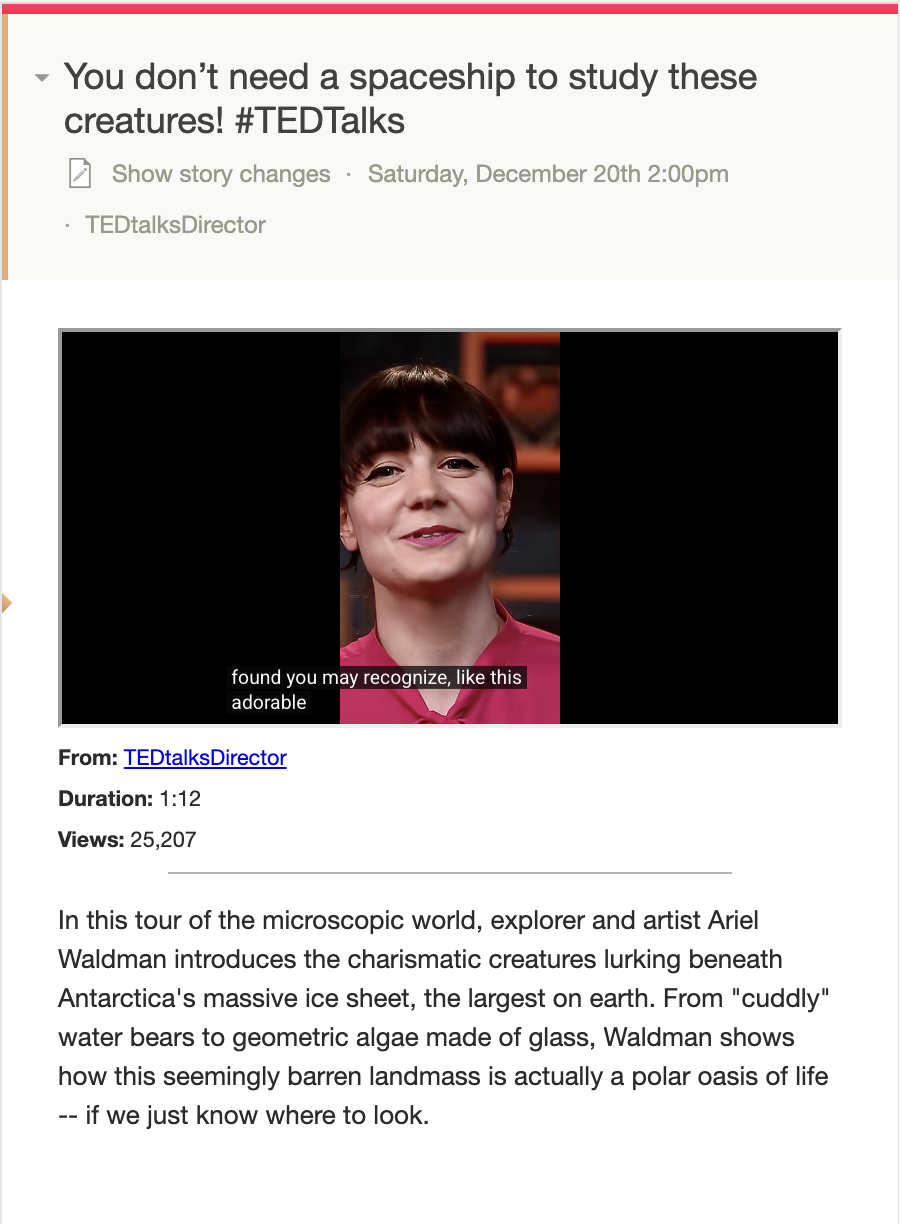
When enabled, any YouTube video in any story will automatically show captions when you start playing it (assuming the video has captions available). This is great for watching videos in noisy environments, for accessibility, or for following along in a language you’re learning.
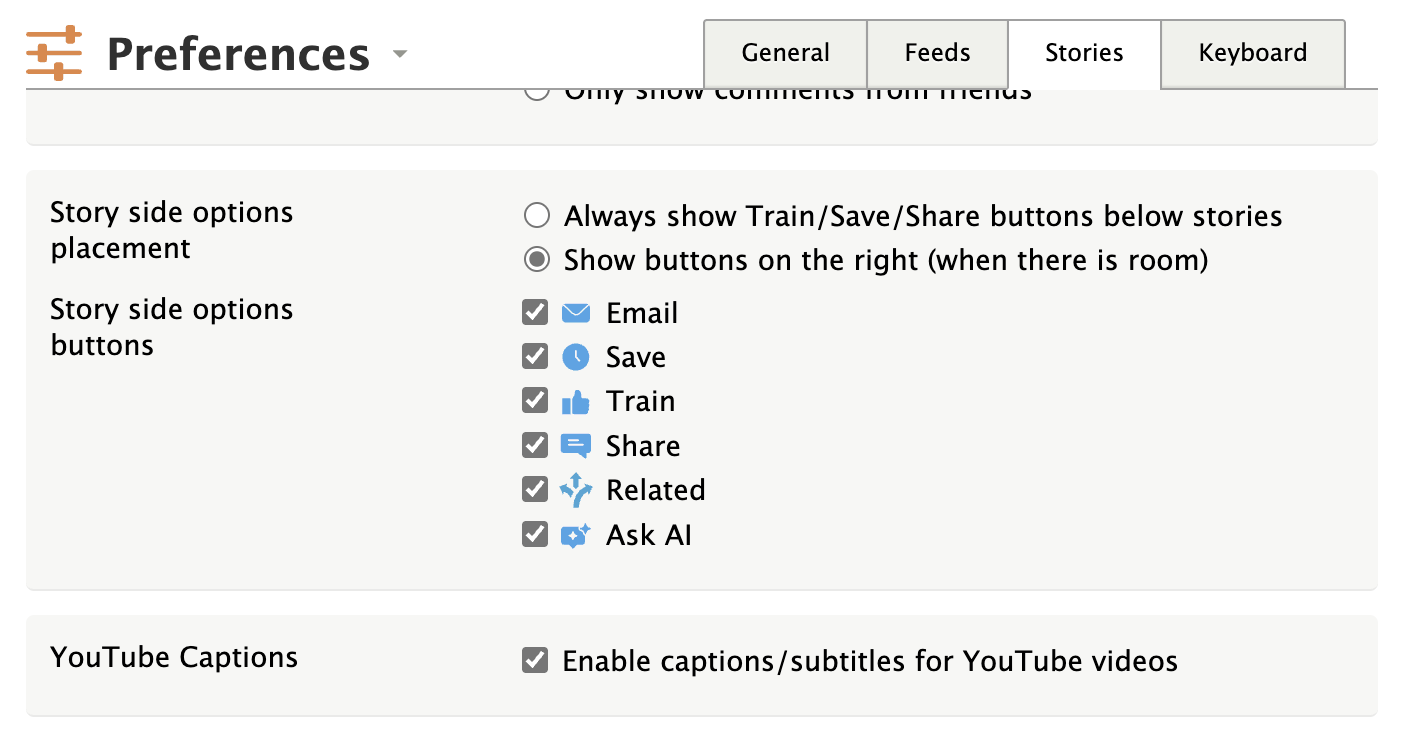
This works by adding the
cc_load_policy=1parameter to YouTube embed URLs on-the-fly, so it applies to all your feeds without modifying the original content. The preference is off by default, so existing behavior is unchanged unless you opt in. -
Today we’re launching text-based intelligence classifiers, a powerful new way to train NewsBlur to show you exactly what you want to read. You’ve always been able to train NewsBlur’s intelligence using story titles, authors, tags, and publishers. Now you can train on any phrase that appears in the full text of a story. This feature is available exclusively to NewsBlur Premium Archive subscribers.
Text-based classifiers work just like the intelligence training you’re already familiar with. Find a phrase you care about, mark it as something you like or dislike, and NewsBlur will automatically highlight or hide future stories containing that phrase. Stories with phrases you like are marked with a green focus indicator, while stories with phrases you dislike are hidden unless you choose to view them.
How to use text-based classifiers
Reading a story and spot a phrase you want to see more of? Simply select the text with your mouse or trackpad, then click the “Train” button that appears.

This opens the intelligence trainer where you can mark the selected text as something you like (thumbs up) or dislike (thumbs down). The text classifier appears at the top of the trainer dialog, ready for you to train.
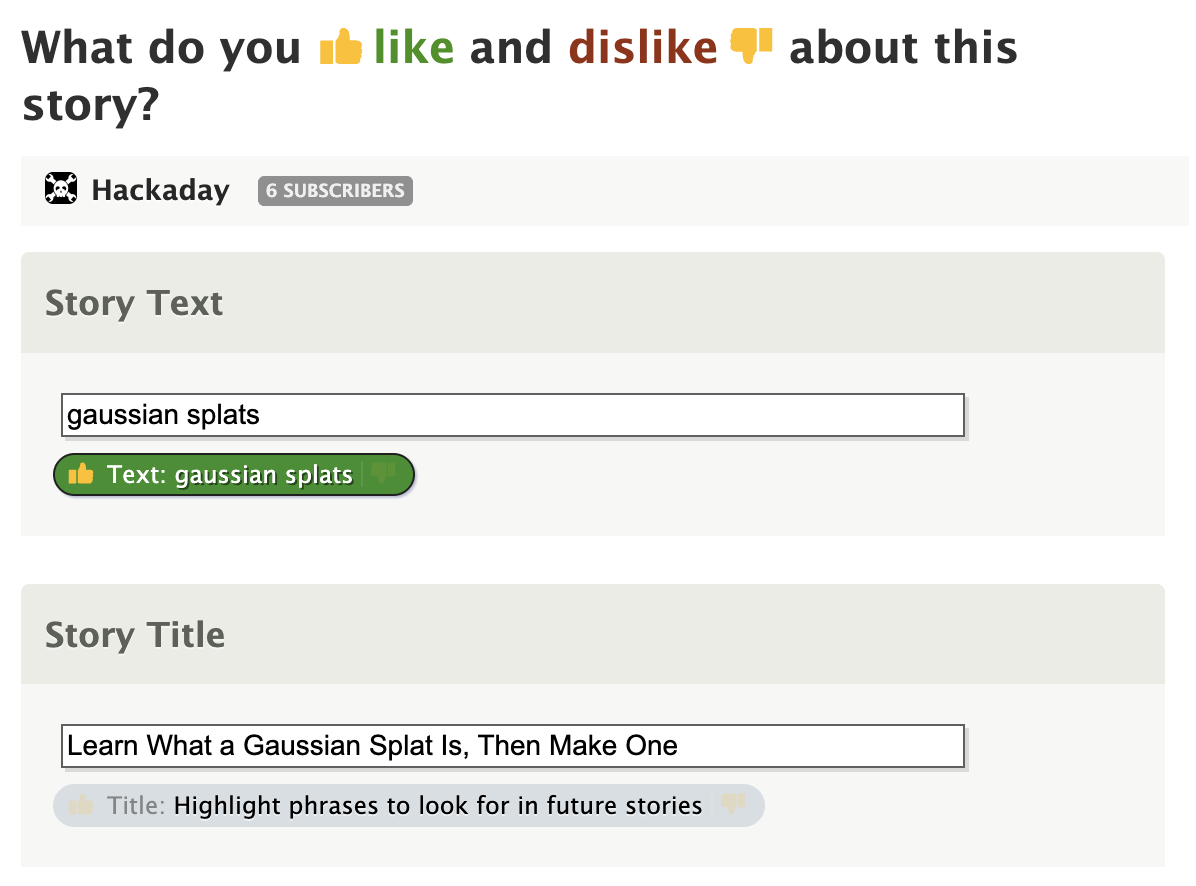
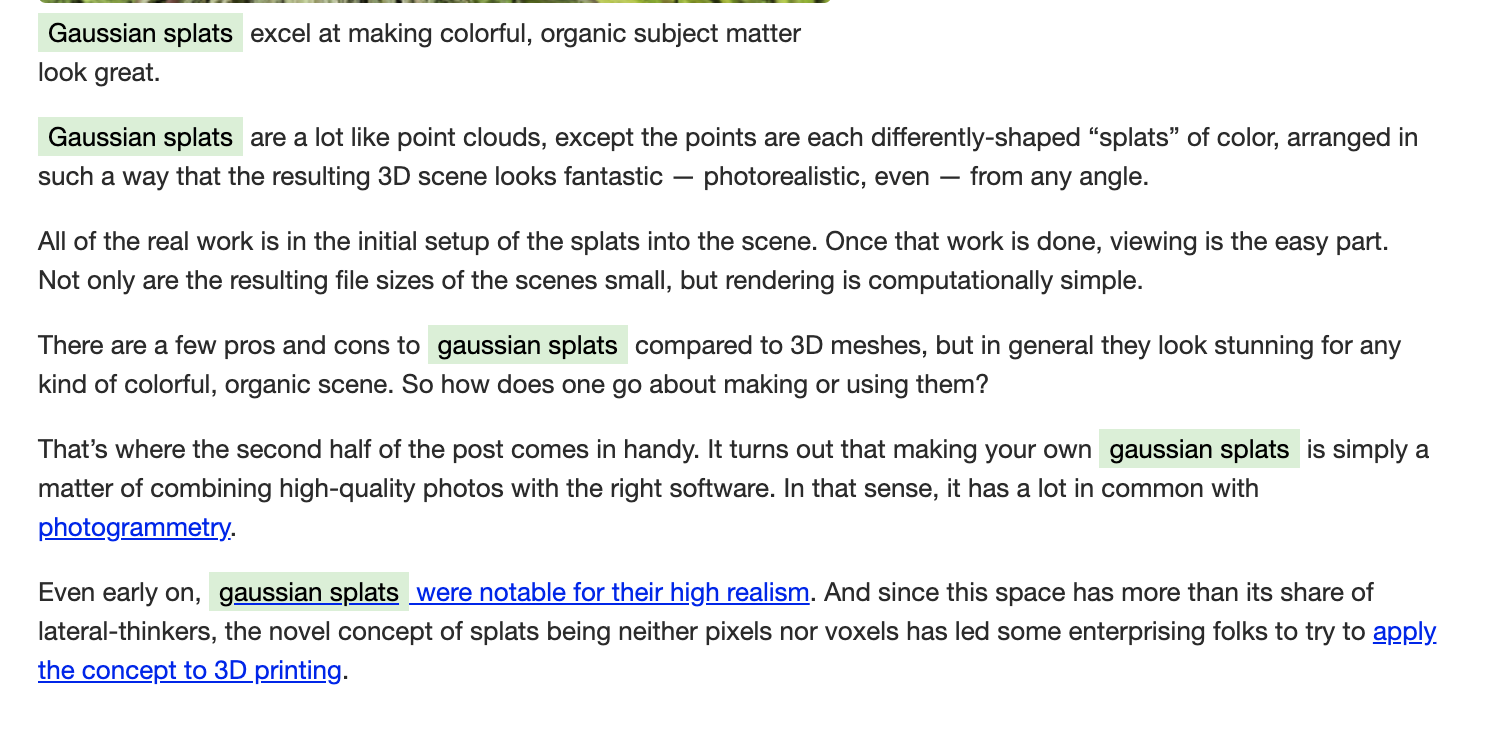
Once you’ve trained a text phrase, NewsBlur will automatically scan the full text of every story from that feed. Stories containing your phrase will be highlighted with a green focus indicator in your story list, making them easy to spot. You can also see the phrase highlighted throughout the story content itself.
Real-world examples
Text-based classifiers shine when you subscribe to broad-interest feeds but only care about specific topics. Here are some examples:
- Subscribe to a food blog that covers everything, but only want to read about vegan recipes? Train on “vegan” and similar terms.
- Reading a tech blog that writes about many frameworks, but you only want stories about your favorite language? Train on that language name.
- Following a news site with mixed content, but only interested in stories about a specific region or topic? Train on location names or topic keywords.
Since text classifiers work on the full article text and not just titles, they catch stories that might not mention your interest in the headline but discuss it in depth within the article.
Green always wins
Just like with other intelligence classifiers, green (focus) always wins. If a story matches both a phrase you like and a phrase you dislike, NewsBlur will mark it as focus and show it in your unread count. This ensures you never miss a story about something you care about, even if it also contains topics you’re less interested in.
You can view your focus stories by choosing between Unread and Focus at the bottom of the feed list. Set it to Focus to show only green stories and see everything NewsBlur knows you want to read.
Why Premium Archive only?
Text-based classifiers require scanning the full article content of every story, not just the RSS feed excerpt. The Premium Archive subscription ensures every story is fetched, archived, and available for full-text search and classification. This means your text classifiers work on every story from every feed you subscribe to, with no gaps in coverage.
The Premium Archive subscription also includes unlimited story archiving, the ability to mark any story as unread forever, full-text search across your entire archive, and the discover stories feature for finding related content across all your feeds.
Available now on the web
Text-based classifiers are available now to all Premium Archive subscribers on the web. Simply highlight any phrase in a story, click the “Train” button, and start training. iOS and Android support is coming soon.
If you’re not yet a Premium Archive subscriber and want to unlock text-based intelligence training along with unlimited archiving and advanced search, you can upgrade directly on the web.
As always, we’d love to hear your feedback on the NewsBlur forum. For every person who shares their thoughts, there are a dozen others thinking the same thing, so your input helps shape where NewsBlur goes next.
subscribe via RSS